 Book 3📘 CEFR A2・Elementary
Edison: From School Dropout to Inventor — Graded Audiobook Series3 books in this series
Lighting the Night
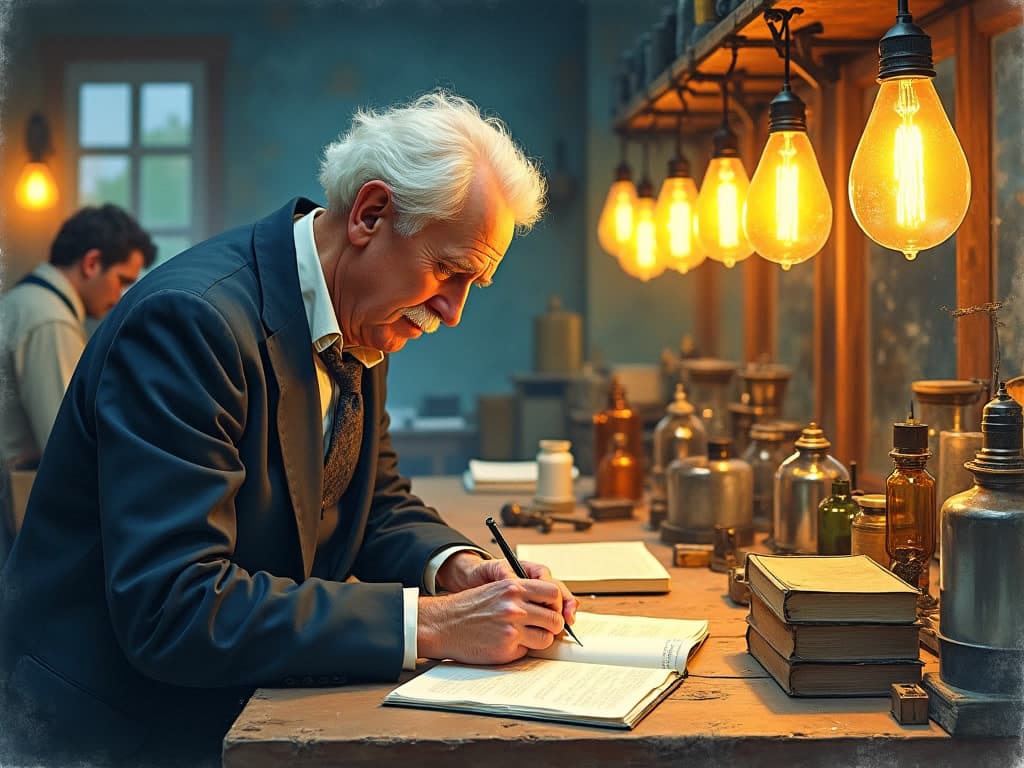
Edison wants every home to have safe electric light. He and his team test endlessly at Menlo Park, facing failure and doubt through long nights, until the first practical light bulb finally brightens people's lives.
CEFR A2・Elementary⏱️ ~9 min📝 1032 words
Edison: From School Dropout to Inventor — Graded Audiobook Series・Book 3
Lighting the Night
0:00
Full story
Text size
Paragraph 1
Edison wanted to make an electric light that ordinary families could use. Gas lamps were bright, but they could be dangerous. A candle could start a fire. Edison imagined a small lamp that was safe, clean, and easy to turn on. Many people said the idea was impossible.
Paragraph 2
He needed more than a bright wire. The wire had to stay hot for a long time without breaking. It needed a glass cover and a way to carry electricity through a whole house. Edison also needed a system that could bring power to many lamps at the same time.
Paragraph 3
In 1876, Edison moved his team to Menlo Park. He built a large laboratory with rooms for machines, tools, books, and tests. Workers could make a part in one room and check it in another. Edison called the place an invention factory. He wanted new ideas to move quickly from a notebook to a real machine.
Paragraph 4
The team tested many kinds of wire. Some wires burned too fast. Some broke when they became hot. Some made a light, but only for a few minutes. Each night, the workers wrote the result on a list. Edison often stayed awake until morning, looking at the small black marks on the page.
Paragraph 5
One worker brought a piece of a plant fiber. Edison watched it burn and wondered if it could last inside a glass bulb. The team tried cotton, paper, wood, and many other materials. They made the air inside the bulb very empty. This helped the thin material last longer.
Paragraph 6
The tests seemed endless. Visitors asked why Edison kept trying when so many tests failed. Edison answered, "We have not failed. We have found many ways that do not work." He knew that a clear record of failure could guide the next experiment.
Paragraph 7
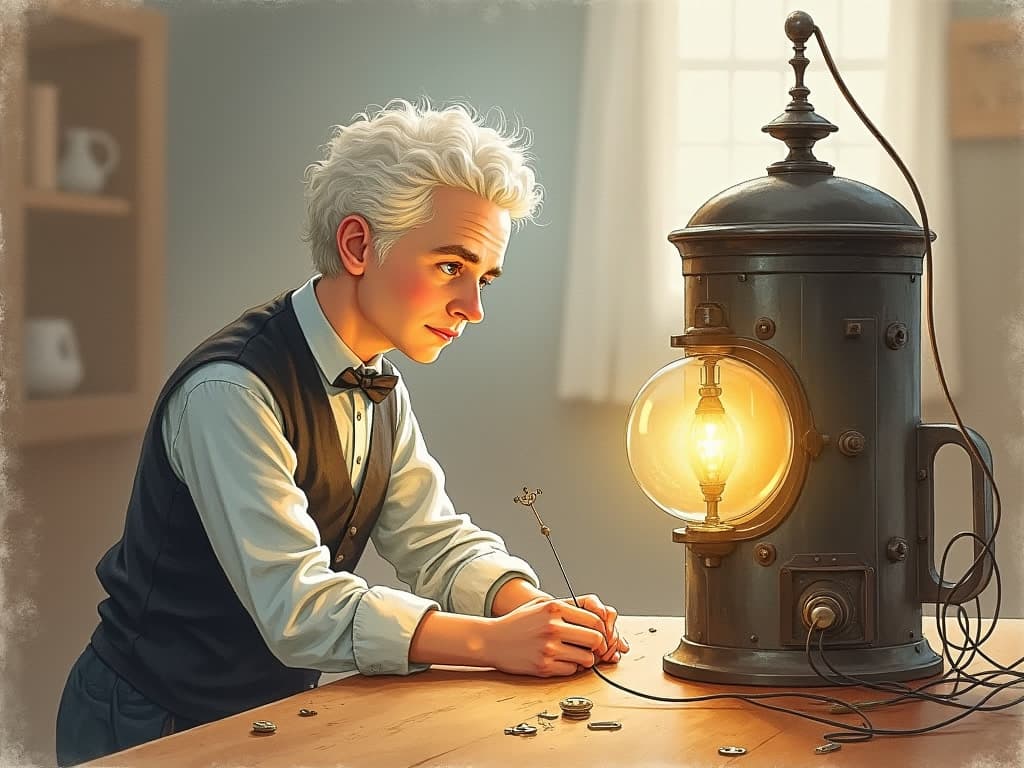
At last, a thin piece of carbon stayed bright for many hours. The light was not perfect, but it was strong enough to show a new path. Edison and his workers cheered when the lamp continued to shine through the night. They still had to make a full system, but the hardest question had a hopeful answer.
Paragraph 8
Edison built a generator to make electricity. He designed wires, switches, and meters to control it. He made a lamp with a simple screw so a family could replace it. He thought about the person who would use the invention, not only the person who would build it.
Paragraph 9
On New Year's Eve in 1879, people came to Menlo Park to see the new light. The road was full of visitors. Inside the laboratory, small bulbs shone over the tables. The warm light looked different from the hard flame of a gas lamp. People stood quietly and looked at one another with surprise.
Paragraph 10
The work was not finished. Edison had to show that the light could travel from a central station to many buildings. He worked with engineers and business partners. There were arguments about money, design, and safety. Edison listened, changed some plans, and continued to test.
Paragraph 11
Soon, streets and homes began to use electric light. The change did not happen in one night. It came from thousands of notes, many tired workers, and a long line of experiments. Edison became known as the Wizard of Menlo Park, but he always spoke about the team behind the work.
Paragraph 12
Edison made many other inventions during his life. He improved the phonograph, worked with motion pictures, and studied batteries. Some ideas worked well. Others did not. He kept the same habit: ask a question, make a test, study the result, and try again.
Paragraph 13
The first bright bulb was only one part of the plan. Edison had to teach people how to use electricity safely. His team made switches that could stop the current. They covered wires so a person would not touch bare metal. They placed meters in buildings so workers could see how much power each lamp used.
Paragraph 14
Some visitors still believed gas was better. They said electric light was too expensive and too strange. Edison invited them to Menlo Park at night. He turned on a row of lamps and let them compare the clean light with a smoky flame. He did not ask them to trust a promise. He asked them to look at the result.
Paragraph 15
The work also changed the workers. They learned to share notes instead of hiding an idea. They learned to ask for help when a test stopped them. A young worker could discover a useful answer, and Edison would write it on the main board. The invention factory belonged to the whole team.
Paragraph 16
Years later, people remembered the shining bulbs, but Edison remembered the dark hours before them. He remembered cold coffee, tired eyes, broken parts, and pages full of crossed-out plans. Those moments were not separate from success. They were the road that led to it.
Paragraph 17
When Edison looked back, he did not say that he had been smarter than everyone else. He said that he had stayed with the question longer. Curiosity began the work, but courage kept it moving. A person can learn from a book, a teacher, a friend, or a failed test. The important thing is to keep looking, keep asking, and keep trying.
Paragraph 18
The light became a picture of that lesson. On the first night, a small flame could shine for a short time. On another night, the bulb stayed dark. In the next year's tests, the team found a stronger material. Edison was not smarter because he knew every answer. He became wiser because he kept asking better questions.
Paragraph 19
Today, we often turn on a light without thinking about the work behind it. We see only the bright room. We do not see the notes, tools, and quiet tests that made it possible. Edison's story helps us see the hidden work in every useful idea. A simple result may carry years of effort.
Paragraph 20
The boy who had left school became one of the world's best-known inventors. His success did not come from one magic moment. It came from curiosity, patient work, and the courage to learn from mistakes. His story reminds us that a difficult beginning does not have to decide the end.
Lighting the Night
Tap to play the audiobook
Auto-playing next book(5s)
Robinson Crusoe — Graded Audiobook Series · Book 1: Leaving Home
Edison: From School Dropout to Inventor — Graded Audiobook Series — all books
Vocabulary from this book
You haven't saved any words from this book yet
Tap any word in the story and hit "⭐️ Save to my vocabulary" — review cards will show up here once you finish.