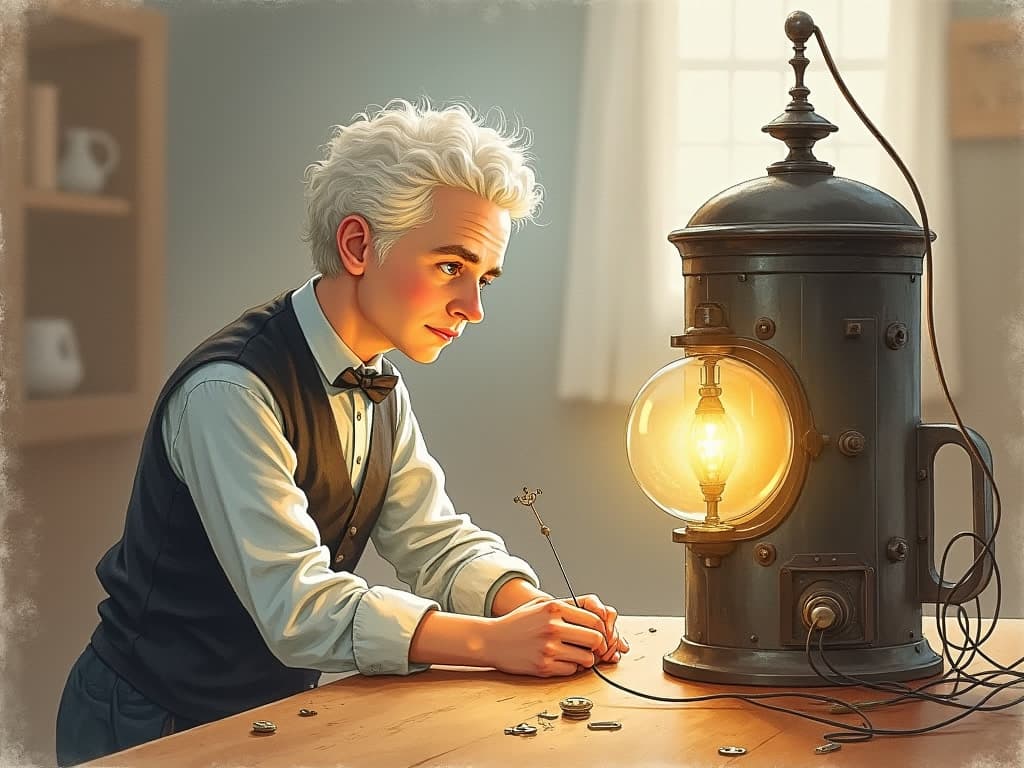
 Book 2📘 CEFR A2・Elementary
Edison: From School Dropout to Inventor — Graded Audiobook Series3 books in this series
A Voice on the Telegraph Line
Edison leaves home to become a telegraph operator. Through nights spent studying electricity and machines, he improves the telegraph and even builds an early recording device with his own voice — finally becoming a true inventor.
CEFR A2・Elementary⏱️ ~9 min📝 1004 words
Edison: From School Dropout to Inventor — Graded Audiobook Series・Book 2
A Voice on the Telegraph Line
0:00
Full story
Text size
Paragraph 1
Thomas Edison was now a young man. He moved from town to town and worked as a telegraph operator. The work was important, but it was not always exciting. During the day, he sent messages for other people. At night, he opened machines and searched for better ways to use them.
Paragraph 2
The telegraph used a key, a battery, and a wire. When an operator pressed the key, electricity moved through the wire. Another machine made a mark at the other end. The system was useful, but it was slow when many messages arrived together. Edison believed one wire could carry more than one message.
Paragraph 3
He built a new machine and tested it again and again. The first tests failed. The second tests also failed. Friends told him to stop and find an easier job. Edison did not see failure as the end. He wrote each result in a notebook and asked what it could teach him.
Paragraph 4
After many tries, his machine sent two messages on one wire. This was a small success, but it gave Edison a chance to work in a larger city. He sold the idea and used the money to buy more tools. He wanted a place where he could work with other people and test many ideas at once.
Paragraph 5
In 1870, Edison opened a workroom in Newark. It was not a beautiful place. Tables were full of wire, metal, paper, and oil. The room was often warm and noisy. Edison did not care. He liked being close to his tools. He wrote on the wall, "There is always a better way."
Paragraph 6
Edison worked on a machine that could print messages without a person standing beside it. He changed the size of the letters and the speed of the moving parts. When the machine made a strange noise, he listened. When it stopped, he looked for the cause. He believed that careful work could turn a rough idea into a useful invention.
Paragraph 7
His friends sometimes became tired. Edison asked them to stay late, but he also worked beside them. He did not ask for a job he would not do himself. The workers learned that he could remember a small detail for many days. He could also change the plan when a new test showed a better path.
Paragraph 8
One evening, Edison talked about a machine that could keep a person's voice. People had written music and words for many years, but a voice disappeared after it was spoken. Edison thought sound might make a mark on a soft surface. Later, another part could read the mark and make the sound again.
Paragraph 9
The idea sounded strange. Edison and his team built a small machine with a metal needle and a turning cylinder. Edison spoke into it. At first, there was only noise. They changed the needle, the speed, and the shape of the surface. They tried one more time.
Paragraph 10
Then the machine spoke back. The voice was not clear, but everyone understood the words. Edison had made an early phonograph. His workers stood around the machine in surprise. Some laughed. Some became quiet. Edison asked them to test it again, because one successful sound was not enough.
Paragraph 11
The phonograph made Edison famous. Newspapers wrote about the young inventor who had made a machine talk. Visitors came to see it. Edison enjoyed the attention for a short time, but he soon returned to his workroom. Fame could not answer his next question. He wanted to make better machines for ordinary people.
Paragraph 12
Edison learned that an invention needed more than a clever idea. It needed strong parts, a simple design, and a way to be made many times. He studied business as well as science. He learned to work with a team and to protect a new idea with a patent.
Paragraph 13
The new attention also brought a new problem. People wanted a machine at once, but the first machine was not ready for every home. It was heavy, and its sound was rough. Edison listened to the complaints without becoming angry. He made a list of changes and went back to the workroom.
Paragraph 14
He asked his team to make the machine smaller. One person worked on the cylinder. Another worked on the needle. A third person tested the sound in a quiet room. Edison moved from table to table and asked simple questions. Which part was strong? Which part broke? Which part could a child use safely?
Paragraph 15
Edison understood that useful inventions must be easy to explain. A machine could be clever, but people would not buy it if they could not use it. He wrote short directions and drew a picture beside each step. This was another kind of invention: making new science clear to ordinary people.
Paragraph 16
The workroom taught Edison to be patient with people as well as machines. A tired worker could miss a small detail. A new idea could sound wrong at first. Edison asked everyone to show the result of a test before they made a final decision. Sometimes the youngest person in the room found the best answer.
Paragraph 17
When a result surprised him, Edison did not hide it. He placed the paper on the table and invited the team to read it. One person might notice a change in the sound. Another might see that the wire was too weak. Together they could make a better decision than one person working alone.
Paragraph 18
As his work grew, Edison began to dream about a large laboratory. He wanted a place with books, tools, and people from many fields. A chemist could help with a material. A builder could make a strong part. A musician could test a recorded voice. Edison believed that different minds could make one idea better.
Paragraph 19
The road ahead was still long. Edison had many plans, but he knew that each plan would bring new problems. He looked at the wire, the battery, and the turning cylinder in his room. Then he wrote a new question in his notebook: how could electricity bring safe light to every home?
A Voice on the Telegraph Line
Tap to play the audiobook

Auto-playing next book(5s)
Edison: From School Dropout to Inventor — Graded Audiobook Series · Book 3: Lighting the Night
Edison: From School Dropout to Inventor — Graded Audiobook Series — all books
Vocabulary from this book
You haven't saved any words from this book yet
Tap any word in the story and hit "⭐️ Save to my vocabulary" — review cards will show up here once you finish.