 Book 1📘 CEFR A2・Elementary
Edison: From School Dropout to Inventor — Graded Audiobook Series3 books in this series
The Young Experimenter
Young Thomas Edison struggles at school but keeps learning at home and on the train through sheer curiosity. Between small experiments, books, and one accidental fire, he starts to find his own path.
CEFR A2・Elementary⏱️ ~9 min📝 1036 words
Edison: From School Dropout to Inventor — Graded Audiobook Series・Book 1
The Young Experimenter
0:00
Full story
Text size
Paragraph 1
In 1847, a boy named Thomas Edison was born in a small town in Ohio. His family called him Tom. Tom was not like other boys. He asked questions all day. Why did a bird fly? Why did water turn into ice? Why did a light go out when the wind came? His mother smiled, but sometimes she needed a rest.
Paragraph 2
At school, Tom asked many questions. His teacher wanted the children to sit still and repeat the lesson. Tom could not do that for long. He wanted to understand how things worked. One day, the teacher said that Tom was a difficult child who could not learn. Tom went home with tears in his eyes.
Paragraph 3
His mother did not believe the teacher. She had been a teacher herself. She looked at Tom and said, "You are not a bad child. You are a curious child. We will learn together at home." From that day, she gave him books and allowed him to ask questions. Tom never forgot her trust.
Paragraph 4
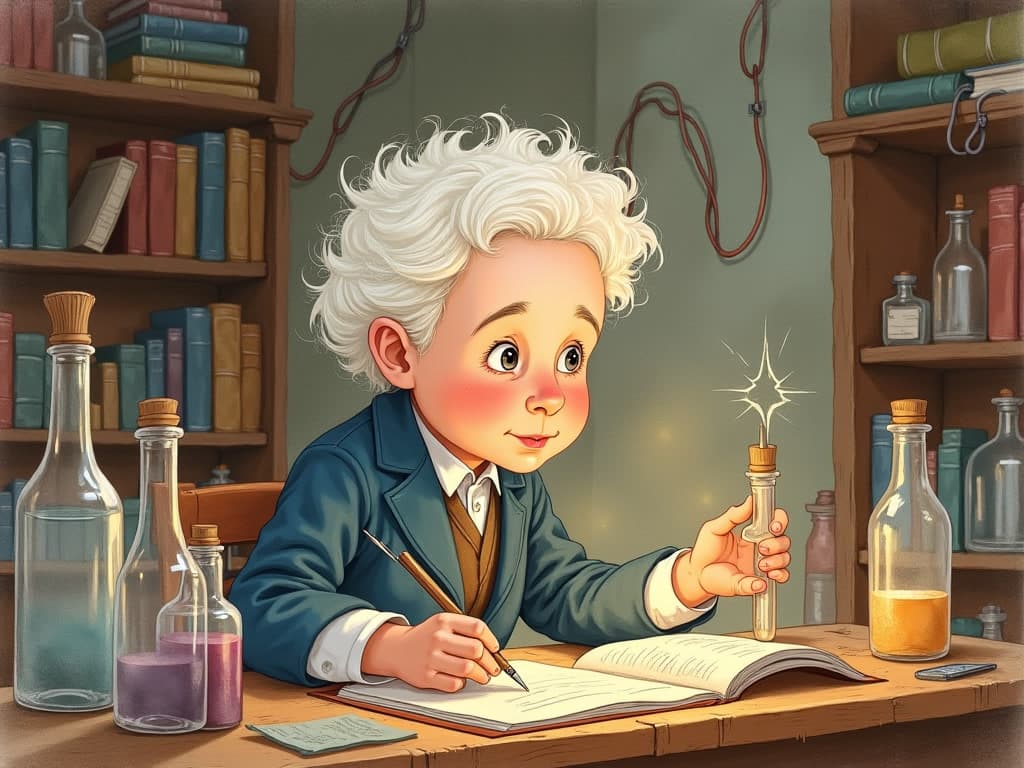
Tom read about science, history, and machines. He did not only read. He tried to see each idea with his own eyes. He made a small room in the house for experiments. There were bottles, wire, wood, and old tools on a table. His mother asked him to be careful, but she did not stop his work.
Paragraph 5
When Tom was twelve, he found a job on a train. He sold newspapers and small food to people who were traveling. The train moved through towns and fields every day. Tom liked the work because he could meet many people and see many new places.
Paragraph 6
The train had a small empty room. Tom asked if he could use it. He carried his books and tools there and made another little laboratory. He studied while the train was moving. He watched the wheels, the smoke, and the strong sound of the engine. He wanted to know how the machine made such power.
Paragraph 7
One afternoon, Tom made a small fire in the room. A bottle fell, and the fire grew quickly. The train worker saw the smoke and became very angry. He threw Tom's tools and books onto the floor and sent him out of the room. Tom was sad, but he did not stop being curious.
Paragraph 8
Tom also had trouble hearing. After a loud accident on the train, sounds became quiet for him. Some people thought this was only a problem. Tom saw another side. He could work for a long time without hearing every voice around him. He could think deeply and listen closely to the sounds that mattered.
Paragraph 9
Tom helped a young child near the train one day. The child was close to the moving cars and did not see the danger. Tom pulled him away in time. The child's father worked with a telegraph, a machine that sent short messages through wire. To thank Tom, he taught him how to use it.
Paragraph 10
Tom loved the telegraph. A message could travel far faster than a train. He learned the code and practiced at night. Soon he could send and receive messages better than many older workers. He understood that a machine could change the way people lived.
Paragraph 11
Tom left the train and found work in a telegraph office. He carried his books with him and kept asking questions. When a machine failed, he did not simply wait for help. He opened it, found the broken part, and tried to fix it. Each mistake became a new lesson.
Paragraph 12
Some people laughed at the young worker. They said he would never become important. Tom remembered his mother. He knew that school was not the only place to learn. A quiet room, a useful book, and a patient experiment could also be a school.
Paragraph 13
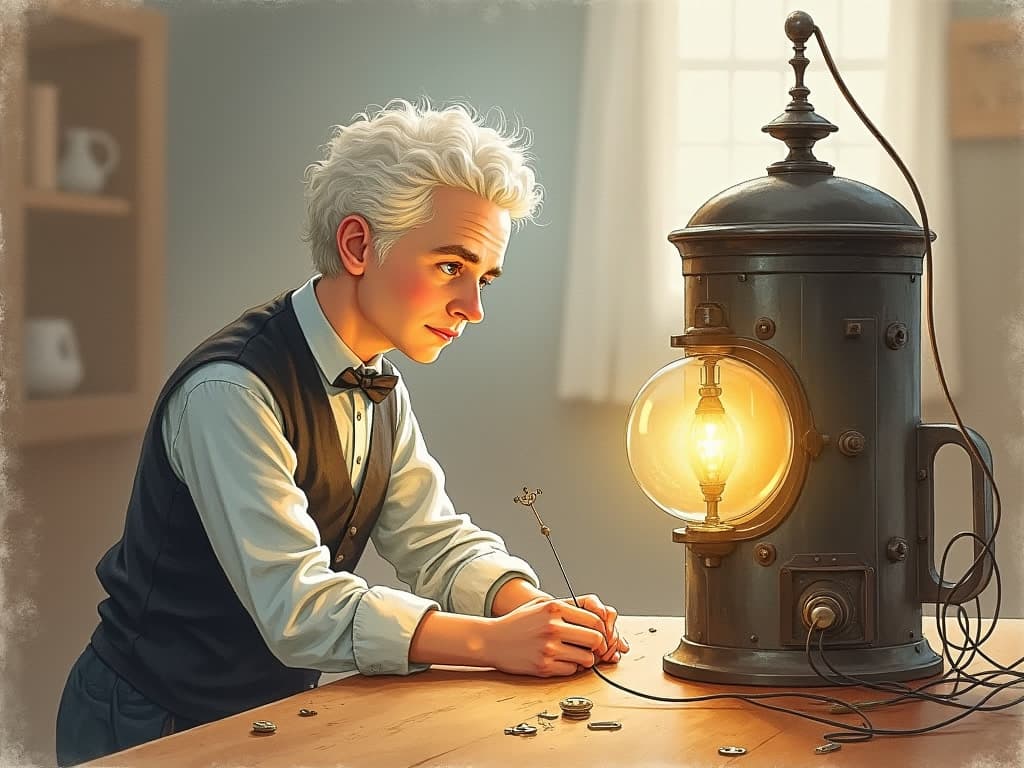
Tom saved money for better tools. He bought a small battery and more wire. At night, he placed the battery on a table and watched a tiny spark jump between two ends. He learned that a spark could be bright but short. A steady current was harder to make, and that problem made him want to work even more.
Paragraph 14
He wrote careful notes about every test. If the wire was long, the message became weak. If the battery was old, the machine moved slowly. Tom changed one thing at a time so he could see the real cause of each result. This habit stayed with him for the rest of his life.
Paragraph 15
Tom also learned from people around him. An older operator showed him how to listen for a quiet signal. A printer taught him to keep paper dry. A traveler told him about offices in other cities. Every person gave him a small part of his education, and Tom kept those parts in his memory.
Paragraph 16
At home, his mother read his notes. She did not understand every machine, but she understood Tom. She asked, "What did you learn today?" Tom never answered only, "It worked" or "It failed." He explained why he thought the test had that result. In this way, his first teacher helped him become a careful thinker.
Paragraph 17
Tom's first experiments were not always safe or successful. A tiny spark could make him jump, and a steady current could heat a wire. He learned to keep water near the table and to put every tool back after a test. He also learned to ask for help. A young inventor did not need to know everything. He needed to notice a problem, write it down, and return to it with a calm mind.
Paragraph 18
Sometimes the result of a test was only a small change. The light lasted one second longer, or the message arrived a little faster. Tom still wrote it down. He knew that a small change could become important after many more tests. He was learning to be patient, and patience would become one of his greatest tools.
Paragraph 19
At the end of his first journey, Tom looked at an old wire and a bright spark. He did not yet know what he would invent. He only knew that he wanted to understand the hidden power in the wire. The boy who had left school was ready to begin a different kind of education.
The Young Experimenter
Tap to play the audiobook
Auto-playing next book(5s)
Edison: From School Dropout to Inventor — Graded Audiobook Series · Book 2: A Voice on the Telegraph Line
Edison: From School Dropout to Inventor — Graded Audiobook Series — all books
Vocabulary from this book
You haven't saved any words from this book yet
Tap any word in the story and hit "⭐️ Save to my vocabulary" — review cards will show up here once you finish.