 Book 3📘 CEFR A2・Elementary
Marie Curie: Radiant Light from the Laboratory — Graded Audiobook Series3 books in this series
Two Nobel Prizes and the War Effort
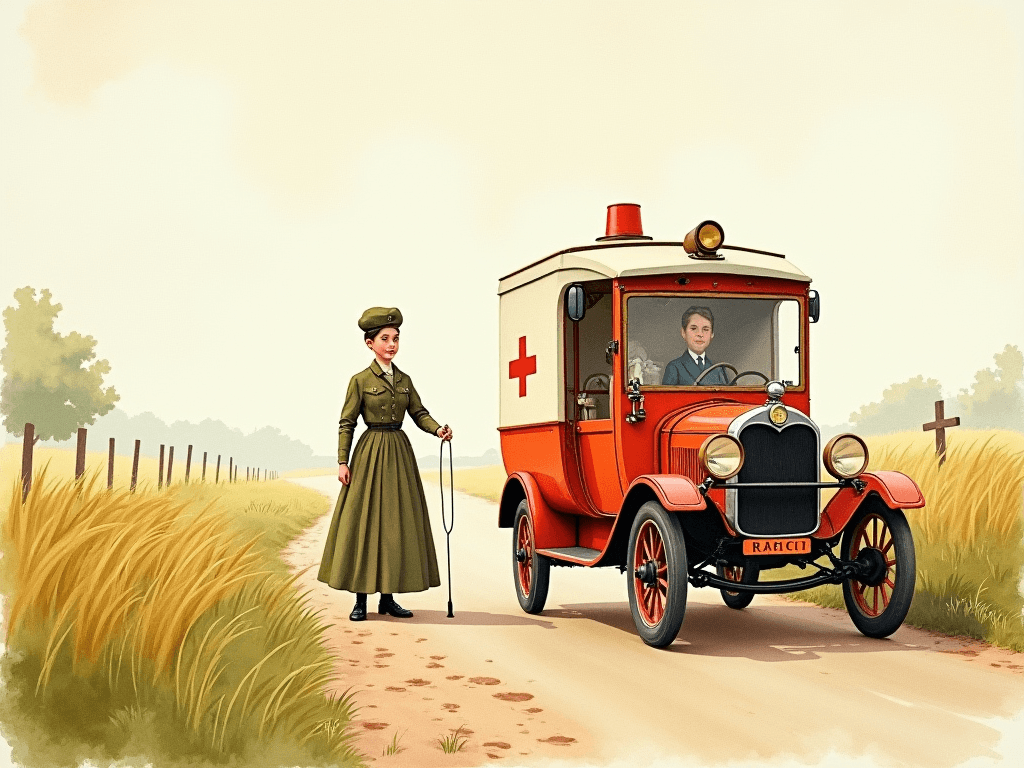
After Pierre's sudden death, Marie turns grief into strength, becomes the Sorbonne's first female professor, and wins a second Nobel Prize, this time in Chemistry. When war breaks out, she drives X-ray ambulances to the front lines herself, saving countless wounded soldiers.
CEFR A2・Elementary⏱️ ~10 min📝 904 words
Marie Curie: Radiant Light from the Laboratory — Graded Audiobook Series・Book 3
Two Nobel Prizes and the War Effort
0:00
Full story
Text size
Paragraph 1
Following the Nobel Prize ceremony, Pierre and Marie Curie were propelled into sudden international fame. Journalists, scientists, and dignitaries from around the globe flocked to Paris to catch a glimpse of the celebrated couple. Yet celebrity and wealth meant absolutely nothing to them. When industrialists offered them enormous sums of money for the commercial patent on their radium extraction method, Pierre and Marie chose to publish their technique freely in scientific journals so that doctors worldwide could use radium to treat cancer.
Paragraph 2
In 1904, the French government finally rewarded Pierre Curie with a prestigious professorship in physics at the Sorbonne University, and Marie was appointed his chief laboratory assistant with an official university salary. In their quiet home on the outskirts of Paris, they raised their two beloved daughters, Irene and Eve. Their home was filled with music, books, and deep family warmth. It seemed that after years of relentless struggle, they had finally found peace, security, and happiness.
Paragraph 3
Then, on a rainy Thursday afternoon in April 1906, an unimaginable tragedy struck. While crossing the busy, rain-slicked intersection of Rue Dauphine in Paris, Pierre Curie lost his footing on the wet cobblestones and fell directly beneath the heavy wheels of a six-ton horse-drawn wagon. He was killed instantly. He was only forty-six years old.
Paragraph 4
When the terrible news reached Marie, she was crushed by an overwhelming wave of grief. The love of her life, her closest friend, and her greatest scientific partner was gone forever. For weeks, Marie sat in silence in her darkened room, her heart shattered into pieces. Yet even in the depths of her deepest sorrow, Marie refused to surrender to despair. She resolved that the only worthy tribute to Pierre's memory was to continue the monumental scientific mission they had begun together.
Paragraph 5
In May 1906, the Sorbonne University offered Marie the university chair that had been created for Pierre. On November 5, 1906, Marie Curie walked into the crowded physics lecture hall to deliver her inaugural address. The room was packed to the ceiling with students, journalists, and world-famous scientists. When the clock struck, Marie stepped calmly to the podium and began her lecture at the exact sentence where Pierre had left off at the end of his previous semester. She had made history once again, becoming the first female professor in the six-hundred-year history of the Sorbonne.
Paragraph 6
Marie poured all her remaining strength into her research. In 1910, after years of meticulous chemical labor, she achieved another historic scientific milestone: she successfully isolated pure, metallic radium in solid form. In 1911, the Swedish Academy of Sciences awarded Marie Curie her second Nobel Prize, this time in Chemistry, for her discovery of radium and polonium and her isolation of pure radium. Marie became the first person in world history to win two Nobel Prizes, and to this day, she remains the only person ever honored with Nobel Prizes in two distinct scientific fields.
Paragraph 7
When World War I erupted across Europe in August 1914, Marie immediately put her scientific genius at the direct service of humanity. She understood that field surgeons near the battle lines were struggling in the dark, unable to locate bullets and shrapnel inside wounded soldiers or properly treat complex bone fractures. Marie realized that mobile X-ray technology could save hundreds of thousands of young lives.
Paragraph 8
Marie emptied the university laboratories of X-ray equipment, persuaded wealthy French citizens to donate automobiles, and converted eighteen commercial delivery trucks into mobile radiology units, which the grateful French soldiers affectionately nicknamed 'Petites Curies—Little Curies. She learned to drive, studied basic automotive mechanics, and traveled directly to the front-line battlefield trenches with her seventeen-year-old daughter Irene. Together, they established two hundred stationary X-ray rooms in field hospitals and personally trained more than one hundred and fifty female radiological technicians.
Paragraph 9
Under constant artillery fire and bombing near the front lines, Marie and her mobile X-ray fleet examined and treated more than one million wounded Allied soldiers. She saved countless lives, prevented tens of thousands of unnecessary amputations, and brought comfort to soldiers in their darkest hours of agony. When the French government later offered her official military medals for her heroic wartime service, Marie humbly declined them, insisting that the saving of human lives was her only reward.
Paragraph 10
In the peaceful years following the Great War, Marie dedicated her life to building the Radium Institute in Paris and founding a second Radium Institute in her beloved hometown of Warsaw. Scientists and researchers from all across the world traveled to Paris to study under her guidance, establishing the foundations of modern nuclear physics and radiation oncology. Marie toured the United States twice, where thousands of American women raised funds to purchase two grams of pure radium to support her ongoing medical research.
Paragraph 11
On July 4, 1934, Marie Curie passed away peacefully in a sanatorium in the French Alps at the age of sixty-six, her health broken by decades of continuous, unprotected exposure to high-energy radiation. In 1995, in recognition of her monumental contributions to humanity, the remains of Marie and Pierre Curie were transferred to the Panthéon in Paris, making Marie the very first woman to be honored in France's sacred national tomb on her own merits. Marie Curie's extraordinary life demonstrated to all humanity that with curiosity, courage, and selfless devotion, human beings can illuminate the deepest mysteries of nature and bring enduring light to the world.
Two Nobel Prizes and the War Effort
Tap to play the audiobook
Auto-playing next book(5s)
The Happy Prince — Graded Audiobook Series · Book 1: The Happy Prince
Marie Curie: Radiant Light from the Laboratory — Graded Audiobook Series — all books

Vocabulary from this book
You haven't saved any words from this book yet
Tap any word in the story and hit "⭐️ Save to my vocabulary" — review cards will show up here once you finish.