 Book 2📘 CEFR A2・Elementary
Marie Curie: Radiant Light from the Laboratory — Graded Audiobook Series3 books in this series
The Shed and the Glowing Elements
In a leaky, unheated old shed, Marie stirs tons of ore by hand through thousands of rounds of purification, discovering two brand-new radioactive elements — polonium and radium — that glow softly in the dark, and earns her first Nobel Prize in Physics.
CEFR A2・Elementary⏱️ ~10 min📝 937 words
Marie Curie: Radiant Light from the Laboratory — Graded Audiobook Series・Book 2
The Shed and the Glowing Elements
0:00
Full story
Text size
Paragraph 1
In the closing years of the nineteenth century, physics was on the verge of a great revolution. In 1895, Wilhelm Röntgen discovered X-rays in Germany, and in 1896, French physicist Henri Becquerel discovered that the heavy metal uranium naturally emitted strange, invisible rays that could penetrate black paper and expose photographic plates. No one in the scientific world understood where this mysterious energy came from or what produced it. Marie Curie found this unsolved puzzle utterly irresistible and chose the study of uranium rays as the subject of her doctoral thesis.
Paragraph 2
To measure the faint electrical currents generated by these mysterious rays, Marie used an ingenious electrometer invented by Pierre and his brother Jacques Curie, which utilized the piezoelectric properties of quartz crystals. With incredible precision and patience, Marie tested every known chemical element and mineral in the university collection. She soon made a groundbreaking discovery: the intensity of the radiation depended solely on the amount of uranium present in the sample, regardless of whether it was hot, cold, solid, or dissolved in acid. This proved that radioactivity was an atomic property, originating from deep inside the atom itself.
Paragraph 3
Then, Marie tested raw mineral ores and made a truly shocking observation: a dense, dark mineral called pitchblende emitted rays that were four times more powerful than pure uranium! Since all the known elements in pitchblende were already accounted for, Marie made a daring scientific hypothesis: pitchblende must contain a minute quantity of a hitherto unknown chemical element that was vastly more radioactive than uranium itself.
Paragraph 4
When Pierre Curie reviewed Marie's meticulous experimental data, he was so astonished by the implications of her discovery that he set aside his own celebrated research on crystals and joined Marie full-time in the laboratory. Together, they embarked on an epic scientific quest to isolate this hidden element from tons of raw mineral ore.
Paragraph 5
However, the Sorbonne University refused to provide them with a proper laboratory. The only workspace available was an abandoned wooden shed across the courtyard of the School of Physics—a drafty shack that had previously been used by medical students to dissect cadavers. The shed had a leaky glass roof that let in rain, a rough asphalt floor, and no heating whatsoever. In the summer, the shed became as suffocating as a greenhouse oven; in the winter, the damp cold was so bitter that Marie's fingers turned blue and stiff as she took scientific notes.
Paragraph 6
Despite these wretched conditions, Pierre and Marie threw their entire souls into their work. Through the generous assistance of the Austrian government and the Vienna Academy of Sciences, they obtained several tons of pitchblende residue from the silver mines of Saint Joachimsthal in Bohemia. Sacks of heavy, dust-covered black rock arrived at their wooden shed, and the monumental task of chemical separation began.
Paragraph 7
Day after day, month after month, Marie performed the exhausting physical labor of an industrial factory worker. Wearing an old, acid-stained smock, she stood over giant cast-iron pots in the open courtyard, stirring boiling cauldrons of pitchblende and acid with a heavy iron rod that was almost as tall as herself. She hauled heavy sacks of ore, poured scalding liquids, and inhaled choking fumes of toxic gas. Yet Marie later remembered those grueling years in the dilapidated shed as the happiest and most heroic period of her entire life, illuminated by the pure joy of discovery.
Paragraph 8
In July 1898, after thousands of tedious chemical separations, Pierre and Marie successfully extracted a new radioactive substance that was four hundred times more active than uranium. In a joint scientific paper, they announced the discovery of a new chemical element. Marie proudly named it polonium, in honor of her beloved, oppressed homeland of Poland.
Paragraph 9
Yet their electrical instruments indicated that an even more powerful substance remained hidden in the mineral residue. On December 26, 1898, the Curies announced the discovery of a second new element, which they named radium, from the Latin word for ray. Radium was more than two million times more radioactive than uranium, possessing an energy so intense that it continuously generated heat and caused surrounding materials to glow.
Paragraph 10
To prove to the skeptical scientific world that radium was a genuine chemical element, Marie had to isolate pure radium and measure its atomic weight. For four agonizing years, from 1898 to 1902, Marie processed more than eight tons of pitchblende residue through thousands of fractional crystallizations. From those vast mountains of black rock, she finally succeeded in extracting a tiny tenth of a gram of pure radium chloride—a sparkling white powder no larger than a grain of sand.
Paragraph 11
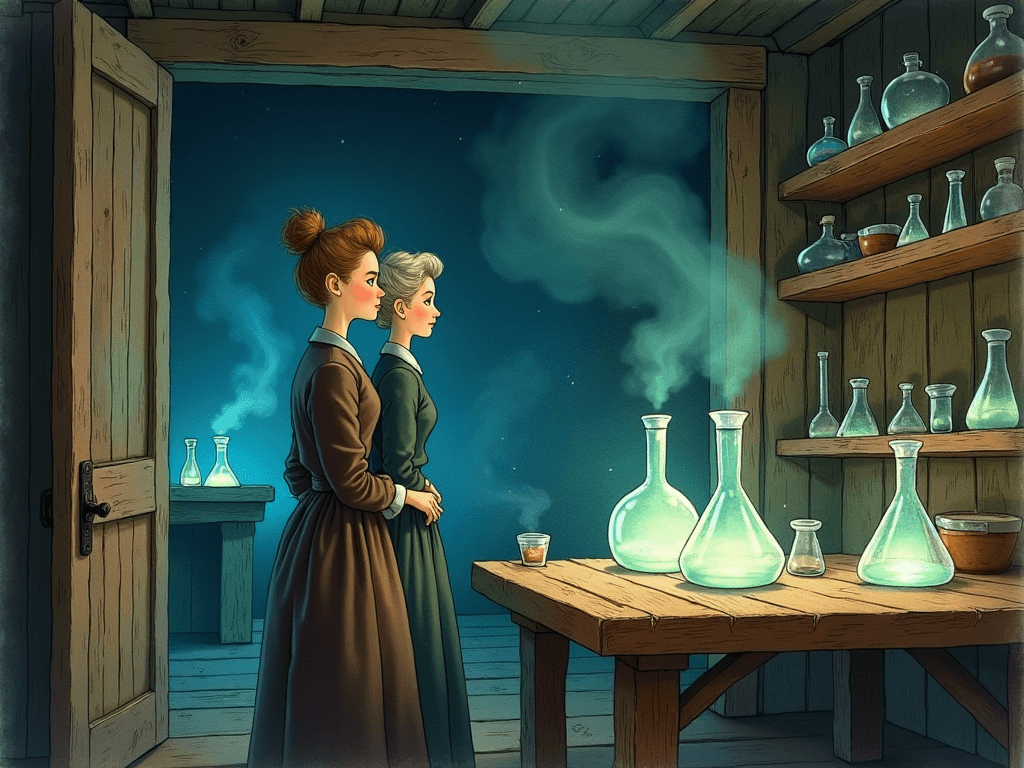
One evening after dinner, Pierre and Marie walked through the dark, quiet streets of Paris back to their humble wooden shed. They unlocked the door and stepped inside without lighting the gas lamps. In the pitch blackness of the workshop, they beheld a breathtaking and unforgettable sight. On the wooden tables and rough wall shelves, the small glass tubes and capsules containing their newly purified radium were glowing with a luminous, ethereal blue-green light. It looked like a constellation of magical stars floating quietly in the dark.
Paragraph 12
In June 1903, Marie defended her doctoral thesis at the Sorbonne, earning her doctorate in physical science with the highest distinction. Later that year, the Royal Swedish Academy of Sciences awarded the 1903 Nobel Prize in Physics jointly to Henri Becquerel, Pierre Curie, and Marie Curie for their monumental discoveries in radioactivity. Marie Curie made history as the very first woman ever to win a Nobel Prize. The world looked on in wonder at the brilliant woman who had illuminated the deepest secrets of the atom.
The Shed and the Glowing Elements
Tap to play the audiobook

Auto-playing next book(5s)
Marie Curie: Radiant Light from the Laboratory — Graded Audiobook Series · Book 3: Two Nobel Prizes and the War Effort
Marie Curie: Radiant Light from the Laboratory — Graded Audiobook Series — all books

Vocabulary from this book
You haven't saved any words from this book yet
Tap any word in the story and hit "⭐️ Save to my vocabulary" — review cards will show up here once you finish.