 Book 1📘 CEFR A2・Elementary
Marie Curie: Radiant Light from the Laboratory — Graded Audiobook Series3 books in this series
From Warsaw to Paris
In a Poland ruled by foreign powers, young Maria studies in secret and tutors others to support her sister. After years of lonely, determined study, she finally reaches the Sorbonne in Paris, graduates top of her class from a freezing attic room, and meets the love of her life, Pierre Curie.
CEFR A2・Elementary⏱️ ~13 min📝 1229 words
Marie Curie: Radiant Light from the Laboratory — Graded Audiobook Series・Book 1
From Warsaw to Paris
0:00
Full story
Text size
Paragraph 1
On a cold, snowy day in November 1867, a baby girl named Maria Sklodowska was born in the historic city of Warsaw, Poland. Her father was a respected teacher of mathematics and physics, and her mother was the headmistress of a prestigious girls' private school. From her earliest childhood, Maria grew up in a home overflowing with books, scientific instruments, and intellectual curiosity. In her father's study stood a tall glass cabinet filled with brass scales, glass prisms, and electrical apparatus. Little Maria would stand on tiptoe for hours, staring with wide, wondering eyes at those mysterious instruments, dreaming of the day when she would understand their secrets.
Paragraph 2
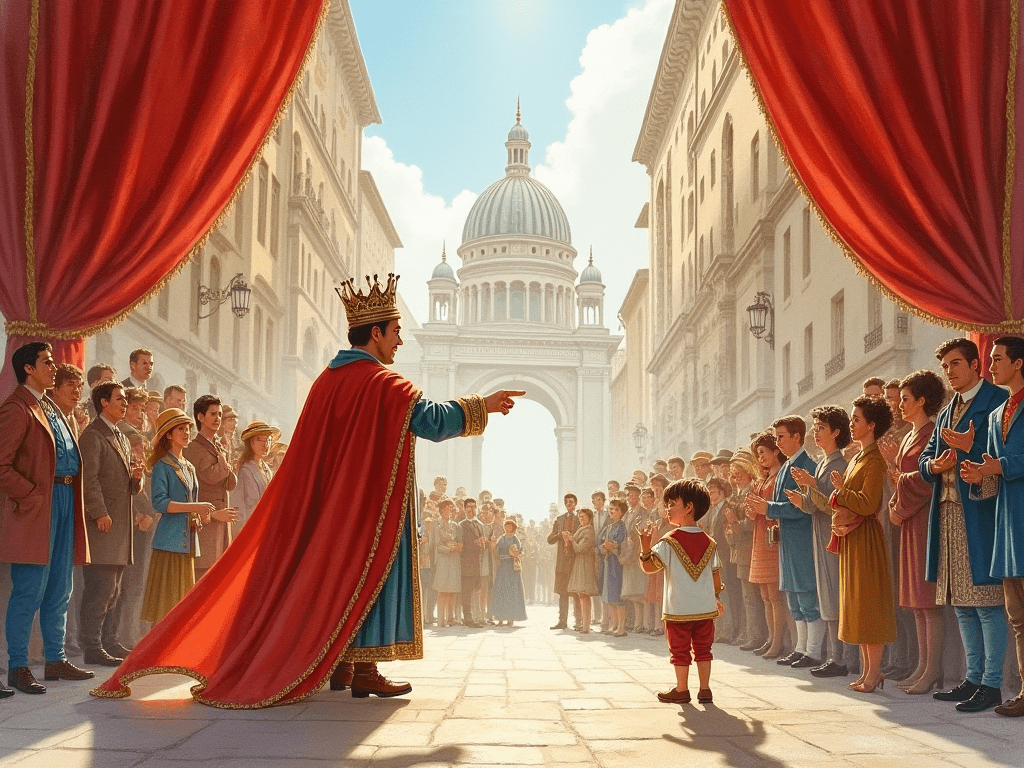
However, Maria's childhood was also marked by great political hardship and personal sorrow. At that time, Poland was conquered and divided by foreign empires. Russian soldiers patrolled the streets of Warsaw, and Polish children were strictly forbidden to speak their native language, read Polish literature, or study their national history in public schools. Whenever government inspectors visited the classroom, Maria—who was always the smartest student with the quickest memory—was called upon to recite Russian history in perfect Russian, hiding her deep love for her homeland behind a calm and composed face.
Paragraph 3
Despite the dark clouds hanging over Poland, Maria graduated from high school at the age of fifteen at the very top of her class, winning a prestigious gold medal for academic excellence. Her greatest dream was to attend university to study natural science and mathematics. But in Poland, higher education was strictly forbidden to women. The official university doors were slammed shut in her face simply because she was female. Yet Maria refused to let prejudice crush her spirit.
Paragraph 4
Maria and her older sister Bronya discovered a secret underground school known as the Flying University. Because the Russian police were constantly hunting for illegal meetings, this clandestine school had no permanent building. Instead, brave professors and eager young students met secretly at night, shifting from private apartments to quiet basements across the city under the cover of darkness. In these hidden rooms, Maria listened to lectures on biology, sociology, and chemistry, fueling her burning thirst for knowledge.
Paragraph 5
Maria knew that to receive a recognized scientific degree, she would have to travel across Europe to Paris, France, and enroll at the famous Sorbonne University. But her family was poor, and her father had lost his savings. Maria and her sister Bronya sat down together and devised a selfless and heroic plan. Maria would remain in Poland and work as a governess and private tutor to pay for Bronya's medical studies in Paris. Once Bronya became a qualified doctor, she would in turn support Maria's education.
Paragraph 6
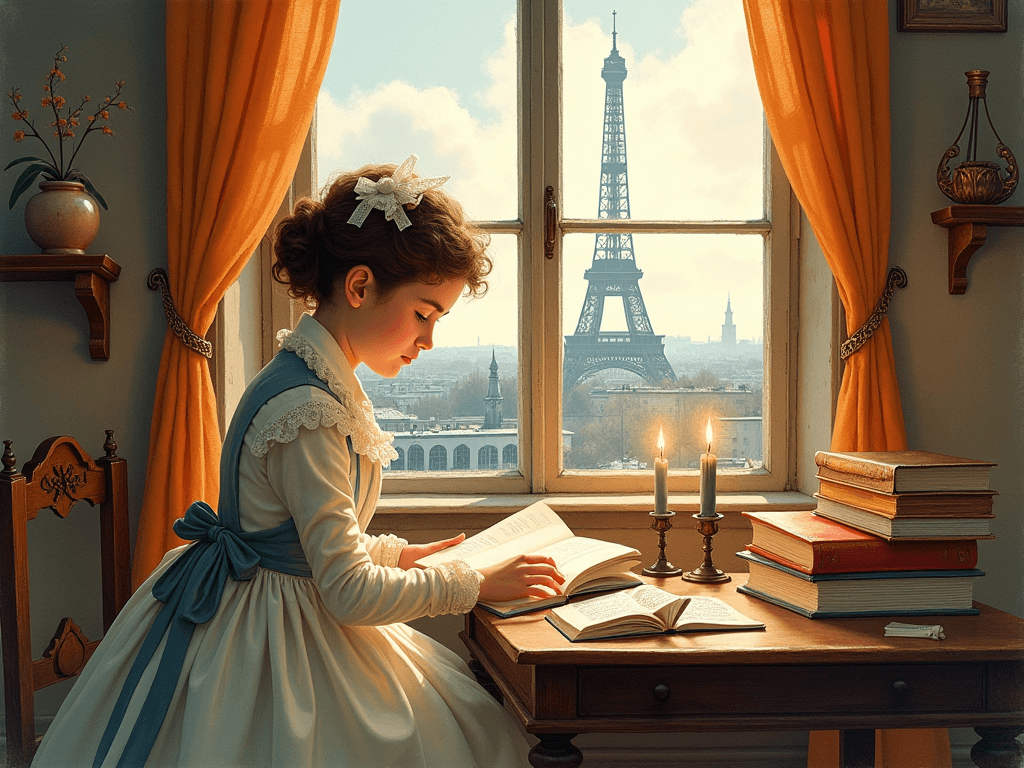
For eight long years, Maria lived in distant country estates, working as a governess for wealthy families. She taught reading, arithmetic, and French to young children by day. But in the quiet evenings, while the rest of the household slept, Maria sat alone by candlelight and devoted every spare hour to rigorous self-education. She read heavy university textbooks on physics and analytical chemistry, solved advanced mathematical equations, and even set up small chemical experiments in a cousin's agriculture laboratory on weekends. Through eight years of loneliness and hard work, her scientific ambition never wavered.
Paragraph 7
Finally, in the autumn of 1891, at the age of twenty-four, Maria's long-awaited moment arrived. Bronya wrote from Paris with joyful news: she was ready to welcome Maria! Maria packed a worn wooden trunk, bought the cheapest fourth-class train ticket, and boarded a three-day train to Paris with a small folding chair and a quilt. When she stepped onto the bustling platform of the Gare du Nord in Paris, she felt as if she had entered a world of boundless freedom and intellectual light.
Paragraph 8
In Paris, she registered at the Sorbonne University, adopting the French spelling of her name: Marie. She was one of only a handful of female students studying science among more than two thousand men. To save money, Marie rented a tiny, freezing attic on the sixth floor of a building in the Latin Quarter. The room had no heating, no lighting, and no running water. In the bitter Parisian winters, the water in her washing basin froze solid overnight, and Marie had to pile all her coats and blankets on top of her bed just to stop shivering.
Paragraph 9
Her daily budget was so meager that she lived almost entirely on dry bread, butter, radishes, and cups of hot tea. Sometimes she became so weak from malnutrition that she collapsed on the library floor. Yet Marie never complained or felt sorry for herself. She spent her days attending lectures by the greatest mathematicians and physicists in France, and her evenings studying in the warm halls of the Sainte-Geneviève library until the gas lamps were turned off at ten o'clock.
Paragraph 10
Marie's extraordinary determination and brilliant intellect produced magnificent results. In 1893, she passed her physics degree with the highest honors, finishing first in her entire class. The very next year, supported by a modest scholarship, she earned a second university degree in mathematics, finishing in second place. Her professors were utterly astonished by her profound grasp of theoretical physics and her tireless dedication to experimental research.
Paragraph 11
In the spring of 1894, Marie received a research grant to investigate the magnetic properties of various steels. Because she needed laboratory space to install large electromagnets, a mutual friend introduced her to a brilliant thirty-five-year-old French physicist named Pierre Curie. Pierre was the laboratory chief at the School of Industrial Physics and Chemistry, already renowned internationally for his groundbreaking discoveries in piezoelectricity, magnetism, and crystal symmetry.
Paragraph 12
When Pierre and Marie first met in a quiet Parisian apartment, they felt an immediate intellectual and spiritual kinship. Pierre was deeply moved by Marie's luminous intelligence, her modesty, and her pure devotion to science. Marie was equally impressed by Pierre's gentle nature, his profound scientific insight, and his total disregard for wealth, power, and worldly fame. They spent long afternoons walking together in the botanical gardens, discussing the deepest mysteries of physics and the laws of nature.
Paragraph 13
Pierre soon fell deeply in love with Marie and asked her to marry him. At first, Marie hesitated because she felt a moral obligation to return to Poland to teach science to her countrymen. However, when she returned to Warsaw in the summer of 1894, Krakow University refused to hire her as a professor simply because she was a woman. Pierre wrote her passionate and eloquent letters, urging her to return to Paris so that they could unite their lives and dedicate their shared strength to scientific discovery.
Paragraph 14
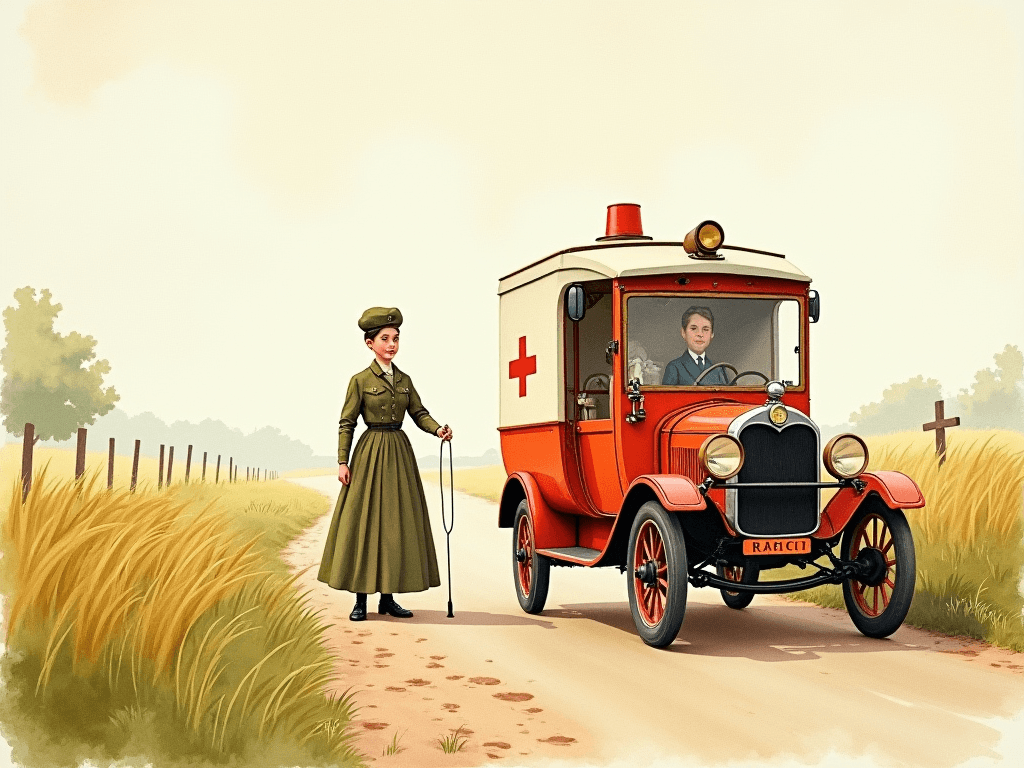
In July 1895, Pierre Curie and Marie Sklodowska were married in a simple, secular civil ceremony. They refused traditional gold wedding rings and fancy banquets. Instead of expensive wedding gifts, they used money given by a relative to purchase two sturdy bicycles. For their honeymoon, they embarked on a glorious cycling journey through the quiet country roads and green forests of France, sleeping in humble village inns and celebrating their love for nature and science.
Paragraph 15
Returning to Paris, the young couple settled into a modest, book-filled apartment. Marie was now preparing to choose a topic for her doctoral thesis—a decision that would soon lead them into uncharted scientific territory, unlock the fundamental secrets of matter, and revolutionize human understanding of the universe forever.
From Warsaw to Paris
Tap to play the audiobook
Auto-playing next book(5s)
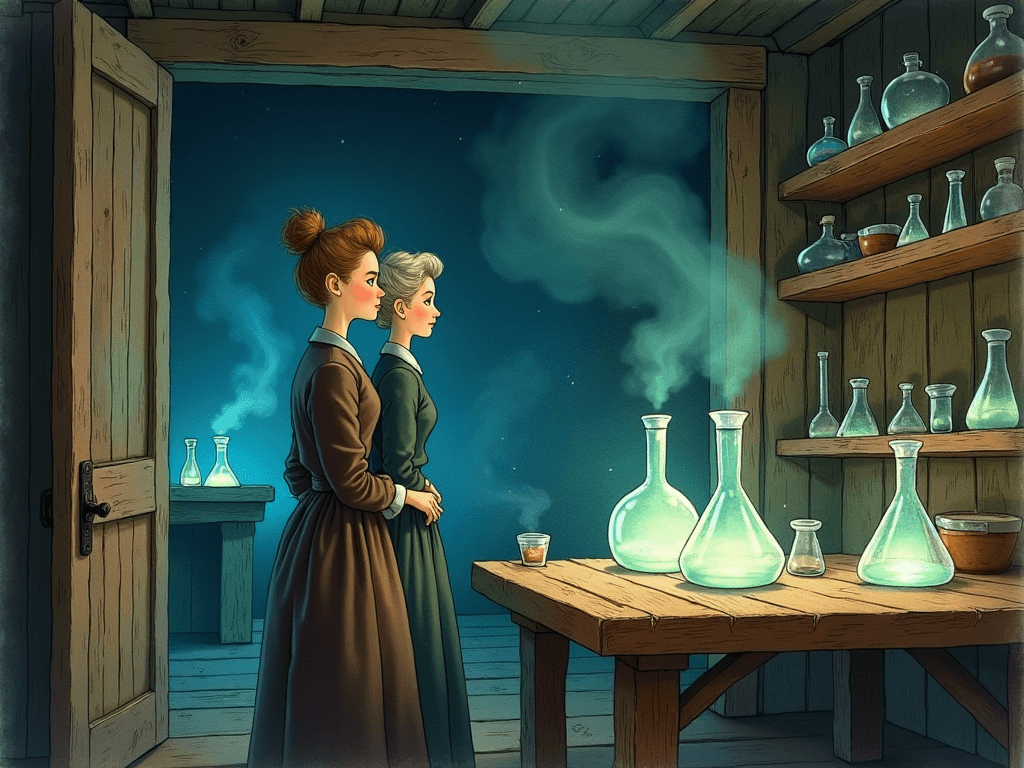
Marie Curie: Radiant Light from the Laboratory — Graded Audiobook Series · Book 2: The Shed and the Glowing Elements
Marie Curie: Radiant Light from the Laboratory — Graded Audiobook Series — all books
Vocabulary from this book
You haven't saved any words from this book yet
Tap any word in the story and hit "⭐️ Save to my vocabulary" — review cards will show up here once you finish.