 Book 1⚡ CEFR B2・Upper-Intermediate
The Wright Brothers — Graded Biography Series1 books in this series
The Wright Brothers: The Bicycle Mechanics Who Conquered the Sky
Neither Wright brother finished college, yet their bicycle-shop instincts led them to question every assumption of earlier flight pioneers. After building their own wind tunnel and testing over two hundred wing shapes, a mere twelve-second flight one cold December morning in 1903 launched the age of human flight.
CEFR B2・Upper-Intermediate⏱️ ~9 min
The Wright Brothers — Graded Biography Series・Book 1Sentence 1 / 35
The Wright Brothers: The Bicycle Mechanics Who Conquered the Sky
0:00
Full story(1/35)
Text size
Paragraph 1
Orville and Wilbur Wright grew up in Dayton, Ohio, in a household that placed remarkably little emphasis on formal academic achievement but an enormous emphasis on curiosity and independent thinking. Their father, a church bishop who traveled frequently, once brought home a small toy helicopter powered by a rubber band, and the brothers' fascination with flight can be traced directly back to that simple childhood gift.
Paragraph 2
The bicycle business proved crucial to their later achievement in more ways than one, providing not only vital mechanical training but also the steady financial income that funded years of costly, unpaid aviation experiments. The brothers deliberately chose to remain financially independent of outside investors, believing correctly that this independence would allow them to pursue their unconventional theories without interference or premature pressure to produce results.
Paragraph 3
Neither brother ever graduated from high school, yet both possessed remarkable mechanical aptitude and an almost obsessive drive to understand how machines worked. Together, they operated a successful printing business and later a bicycle repair and manufacturing shop, experiences that taught them invaluable practical skills in engineering, balance, and precision that would prove essential to their later achievements.
Paragraph 4
By the late 1890s, the brothers had become captivated by news reports of failed and often fatal attempts at powered human flight. Rather than being discouraged by these disasters, they approached the problem with unusual scientific rigor, recognizing that previous inventors had focused almost exclusively on generating sufficient power while largely neglecting the far more fundamental challenge of controlling an aircraft once it was airborne.
Paragraph 5
The brothers' crucial insight, drawn partly from their extensive experience with bicycles, was that a flying machine needed to be actively balanced and steered by its pilot, much as a cyclist continuously adjusts to maintain balance, rather than being passively stable like a boat floating on calm water. This fundamental principle of active control would eventually distinguish their approach from that of virtually every other aviation pioneer of their era.
Paragraph 6
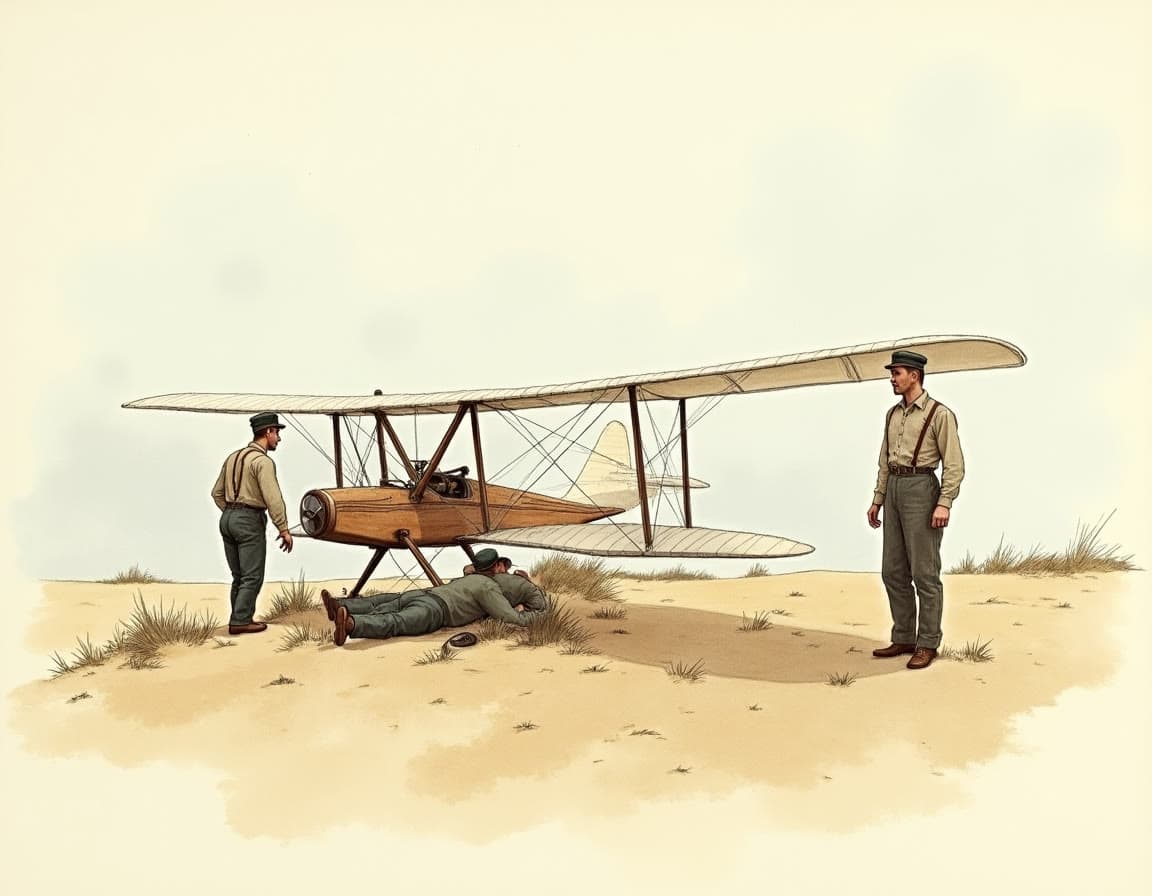
Beginning in 1900, the Wrights conducted a painstaking series of glider experiments on the windswept, sandy dunes of Kitty Hawk, North Carolina, a location they selected specifically for its consistently strong and steady winds. When their initial gliders performed far worse than their calculations had predicted, the brothers grew skeptical of existing aerodynamic data and boldly decided to conduct their own original experiments instead.
Paragraph 7
They constructed a simple wind tunnel in the back of their bicycle shop and meticulously tested more than two hundred different wing shapes, gradually compiling the first genuinely reliable aerodynamic data in the history of human flight. This rigorous, methodical, almost obsessive approach to experimentation set the Wright brothers decisively apart from their more reckless and less disciplined rival inventors.
Paragraph 8
On the cold, windy morning of December 17, 1903, after years of painstaking preparation, the brothers were finally ready to attempt powered flight. Orville piloted their fragile wood-and-fabric aircraft, appropriately named the Flyer, on a historic journey that covered a mere one hundred and twenty feet and lasted only twelve seconds, yet it represented the first sustained, controlled flight of a powered heavier-than-air machine in recorded human history.
Paragraph 9
Remarkably, the momentous achievement initially attracted very little public or media attention. Many newspapers either ignored the brothers' claims entirely or dismissed them as exaggeration, and it would take several more years of steady refinement, public demonstration, and persistent effort before the wider world fully grasped the revolutionary significance of what had actually occurred that December morning.
Paragraph 10
Engine construction posed a further formidable obstacle. Unable to find any commercial manufacturer willing to build a sufficiently lightweight engine, the brothers designed and built their own from scratch, working alongside a skilled mechanic from their bicycle shop. They also discovered, through their painstaking wind-tunnel research, that conventional ship-propeller designs were entirely unsuitable for aircraft, forcing them to invent an original propeller shape based on their own calculations.
Paragraph 11
In the years immediately following their triumph, the Wright brothers became embroiled in a lengthy and bitter series of patent lawsuits against rival aviation pioneers, both in the United States and abroad, whom they accused of copying their crucial method of aircraft control. Although the brothers ultimately prevailed in court, the prolonged legal battles consumed enormous time and energy that might otherwise have been devoted to further innovation.
Paragraph 12
By 1908, the brothers were finally staging highly publicized flight demonstrations in both the United States and Europe, astonishing skeptical crowds and government officials alike with sustained flights lasting well over an hour. Their achievement rapidly attracted military and commercial interest, and within just a few short years, aviation had been transformed from a wildly implausible fantasy into a rapidly growing and increasingly practical industry.
Paragraph 13
The brothers deliberately chose Kitty Hawk for their experiments after writing to the United States Weather Bureau requesting data on locations combining strong, steady winds with soft, forgiving sand for landing. Few outsiders would have considered the isolated, mosquito-infested stretch of coastline appealing, but its consistent conditions made it precisely what two methodical engineers required.
Paragraph 14
On that historic December morning in 1903, the brothers actually made four separate flights, taking turns as pilot, with each successive attempt covering greater distance than the last. Only a handful of local witnesses, mostly members of a nearby lifesaving station, observed the achievement firsthand, and one of them captured the now-iconic photograph of the Flyer lifting off the ground.
Paragraph 15
Wilbur died prematurely of typhoid fever in 1912, while Orville lived on for several more decades, witnessing firsthand the astonishing progress of the aviation industry he and his brother had single-handedly launched. Together, the two humble bicycle mechanics from Ohio had achieved something that had eluded brilliant scientists and engineers for centuries, forever transforming humanity's relationship with the sky above.
Paragraph 16
Within barely a decade of that first fragile flight at Kitty Hawk, nations across the world were racing to build ever faster, more capable aircraft, and within Orville's own lifetime, that same fragile technology had matured into commercial airliners and long-range military aviation, an astonishingly rapid transformation that few witnesses to the brothers' modest 1903 experiment could possibly have foreseen.
Paragraph 17
Both brothers remained lifelong bachelors, devoting themselves so completely to their shared work that friends often remarked they seemed to think and reason almost as a single mind housed in two separate bodies, finishing each other's sentences and rarely, if ever, publicly disagreeing about engineering decisions during their many years of close collaboration.
Paragraph 18
Government and military officials on both sides of the Atlantic had initially dismissed the brothers' claims of powered flight as an implausible exaggeration, having grown weary of numerous earlier inventors who had promised working flying machines and delivered nothing but embarrassing, well-publicized failures. It took repeated, carefully documented public demonstrations before skeptical officials finally accepted that two obscure bicycle mechanics from Ohio had truly succeeded where so many better-funded rivals had failed.
The Wright Brothers: The Bicycle Mechanics Who Conquered the Sky
Orville and Wilbur Wright grew up in Dayton, Ohio, in a household that placed remarkably little emphasis on formal academic achievement but an enormous emphasis on curiosity and independent thinking.
Vocabulary from this book
You haven't saved any words from this book yet
Tap any word in the story and hit "⭐️ Save to my vocabulary" — review cards will show up here once you finish.