 Book 1⚡ CEFR B2・Upper-Intermediate
Abraham Lincoln — Graded Biography Series1 books in this series
Abraham Lincoln: From Log Cabin to the White House
Raised in a rough Kentucky log cabin with almost no formal schooling, Lincoln taught himself law and endured repeated political defeats before becoming president. Amid the fires of civil war, he issued the Emancipation Proclamation and delivered the immortal Gettysburg Address — only to be assassinated just five days after the war's end.
CEFR B2・Upper-Intermediate⏱️ ~9 min
Abraham Lincoln — Graded Biography Series・Book 1Sentence 1 / 35
Abraham Lincoln: From Log Cabin to the White House
0:00
Full story(1/35)
Text size
Paragraph 1
Abraham Lincoln was born in 1809 in a rough, one-room log cabin in the wilderness of Kentucky, into a family so poor that formal schooling was considered an unaffordable luxury. Across his entire childhood, Lincoln attended school for less than a single year in total, yet he developed an insatiable hunger for knowledge, walking considerable distances to borrow books and reportedly reading by the flickering light of the family fireplace long after everyone else had gone to sleep.
Paragraph 2
Lincoln's stepmother, Sarah Bush Johnston, played a quietly crucial role in nurturing his early love of learning, encouraging him to read whenever he could and shielding him, as best she could, from his father's general indifference toward formal education. Lincoln himself later credited her warmly with awakening in him an ambition that his rough frontier upbringing might otherwise have permanently smothered.
Paragraph 3
As a young man, Lincoln worked a bewildering variety of jobs to support himself, including splitting fence rails, piloting river boats, and eventually running a small general store that ultimately failed and left him burdened with substantial debt. Rather than surrendering to these repeated setbacks, he taught himself law by rigorously studying borrowed legal textbooks, and he was formally admitted to the bar in 1836.
Paragraph 4
Lincoln's early political career was marked by a string of disappointing failures interspersed with occasional modest successes. He was defeated in several elections for various public offices, yet each setback seemed only to strengthen his quiet determination rather than diminish it. Friends and colleagues frequently remarked on his extraordinary resilience, along with his uncanny gift for explaining complex ideas through simple, memorable, and often humorous stories.
Paragraph 5
In 1860, Lincoln was elected President of the United States, a victory that immediately provoked a severe national crisis. Several Southern states, deeply alarmed by his perceived opposition to slavery, moved swiftly to secede from the Union rather than accept his authority, and within mere weeks of his inauguration, the country had plunged into the devastating conflict that would become known as the American Civil War.
Paragraph 6
Throughout four grueling years of brutal warfare, Lincoln proved himself a shrewd and remarkably effective wartime leader, despite possessing virtually no prior military experience whatsoever. He carefully assembled a talented and often fiercely contentious cabinet, patiently endured a rapid and demoralizing succession of failed generals, and gradually came to fully appreciate the immense human cost that preserving the Union would ultimately demand.
Paragraph 7
In 1863, Lincoln issued the Emancipation Proclamation, a landmark declaration that formally freed enslaved people living within the rebellious Confederate states. Although the practical, immediate impact of the proclamation was inevitably limited by the ongoing chaos of war, it fundamentally transformed the underlying purpose of the conflict, explicitly linking the Union's ultimate victory to the permanent abolition of slavery throughout the nation.
Paragraph 8
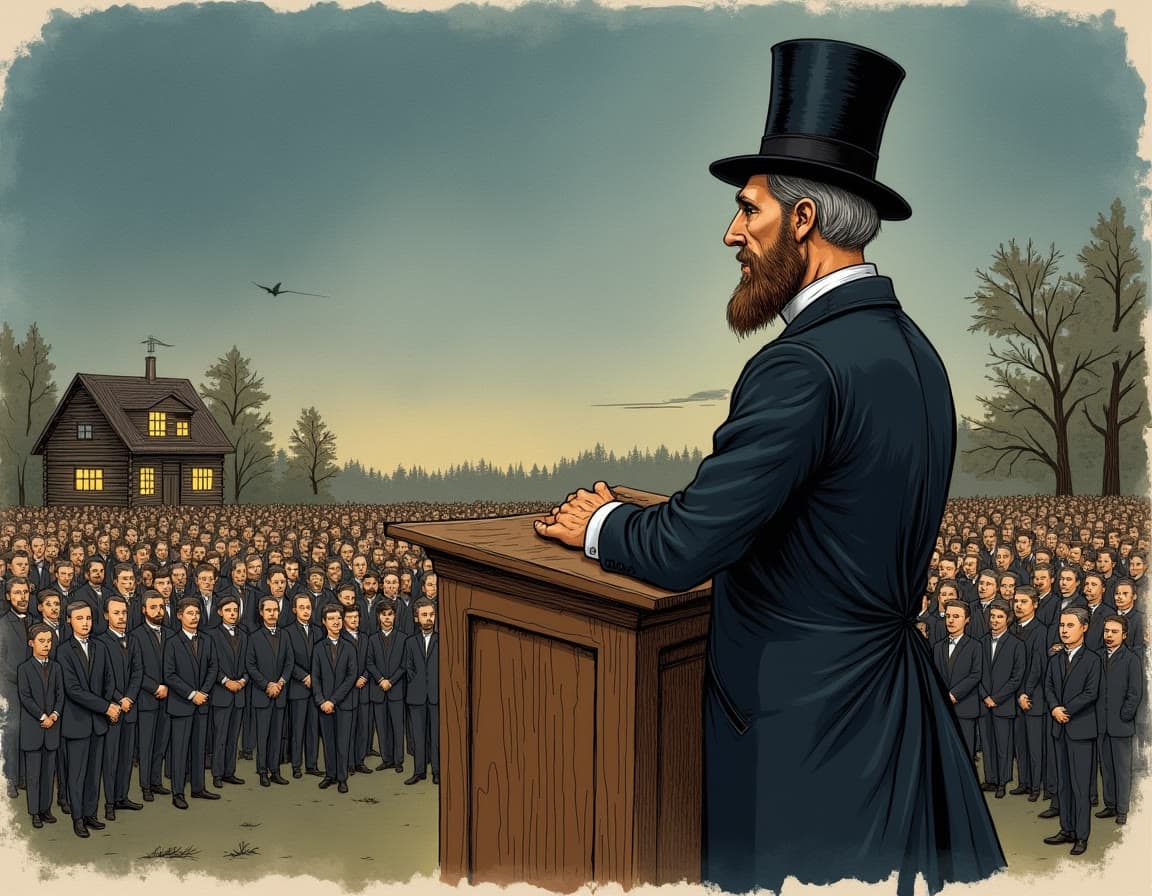
Later that same year, Lincoln delivered his famous Gettysburg Address at the dedication of a military cemetery on the site of one of the war's bloodiest and most consequential battles. Although the speech itself lasted barely two minutes, its eloquent and deeply moving words, honoring the fallen while boldly reaffirming the nation's founding democratic ideals, are still widely regarded today as among the most powerful in the entire history of American political oratory.
Paragraph 9
As the devastating war finally drew to its conclusion in early 1865, Lincoln began cautiously turning his attention toward the formidable challenge of reuniting a deeply divided and traumatized nation. He consistently urged compassion and genuine reconciliation rather than harsh vengeance toward the defeated South, famously articulating his hopeful vision with the memorable phrase, malice toward none, and charity for all.
Paragraph 10
Lincoln's personal life was frequently marked by profound sorrow that ran parallel to his public burdens. His marriage to Mary Todd was often strained by financial pressure and diverging temperaments, and the couple endured the devastating loss of two young sons, tragedies that friends later said left Lincoln visibly older and more melancholy well beyond his actual years.
Paragraph 11
Years earlier, during his 1858 campaign for the United States Senate, Lincoln had gained national attention through a celebrated series of public debates against his rival Stephen Douglas, in which the two men argued fiercely over the expansion of slavery into new territories. Although Lincoln ultimately lost that particular Senate race, the debates showcased his moral clarity and rhetorical skill to audiences well beyond his home state.
Paragraph 12
Tragically, Lincoln would never live to see his ambitious plans for reconciliation carried out. On April 14, 1865, only five days after the Confederate surrender that finally ended the war, he was fatally shot while attending a theater performance in Washington, and he died from his wounds the very next morning, plunging the entire grieving nation into profound national mourning.
Paragraph 13
As president, Lincoln deliberately assembled a cabinet composed largely of his own former political rivals, several of whom had openly considered themselves far more qualified for the presidency than he was. Rather than viewing this as a threat, Lincoln shrewdly recognized that surrounding himself with strong, independent-minded advisors, even ones who initially doubted him, would ultimately produce far better governance than a cabinet of easily agreeable loyalists.
Paragraph 14
Before reaching the presidency, Lincoln had spent years earning his living as a traveling circuit lawyer, journeying on horseback between small rural courthouses across Illinois to argue cases before local juries. This grueling, unglamorous work sharpened his considerable skill at plain, persuasive speech and taught him to communicate complicated legal and moral arguments in terms that ordinary citizens could readily grasp and remember.
Paragraph 15
Abraham Lincoln is now widely and consistently regarded as among the greatest presidents in all of American history, a leader who managed to preserve the fractured Union while simultaneously advancing the fundamental cause of human freedom during the nation's most severe and existential crisis. His humble origins, his hard-won wisdom, and his unwavering moral clarity continue to inspire people around the entire world to this very day.
Paragraph 16
Generations of later leaders, facing their own moments of national crisis, have repeatedly turned back to Lincoln's speeches and personal example for guidance and reassurance. His extraordinary journey from an impoverished, self-taught frontier boy to a president who reshaped the very course of his nation's history remains one of the most powerful stories of perseverance in the entire American national memory.
Paragraph 17
Lincoln's rise from obscurity to national prominence owed a great deal to his exceptional skill as a public speaker, honed over years of courtroom argument and countless small-town political gatherings, where he learned to hold an audience's attention using vivid, homespun stories drawn directly from his own hardscrabble frontier upbringing.
Paragraph 18
Even his political opponents, who fiercely disagreed with his policies throughout his presidency, frequently acknowledged Lincoln's evident personal decency and his striking absence of bitterness or cruelty toward those who opposed him, qualities that stood in sharp contrast to the vicious partisan rhetoric that otherwise characterized the deeply polarized political climate of his turbulent era.
Abraham Lincoln: From Log Cabin to the White House
Abraham Lincoln was born in 1809 in a rough, one-room log cabin in the wilderness of Kentucky, into a family so poor that formal schooling was considered an unaffordable luxury.
Vocabulary from this book
You haven't saved any words from this book yet
Tap any word in the story and hit "⭐️ Save to my vocabulary" — review cards will show up here once you finish.