 第 1 册⚡ CEFR B2・中高级
《南丁格尔》名人传记有声书全系列共 1 册
南丁格尔:提灯天使与现代护理之母
Florence Nightingale: The Lady with the Lamp
出身英国富裕家庭的南丁格尔,不顾家人反对投身当时被视为低贱的护理工作。克里米亚战争期间,她彻底整顿肮脏的野战医院,让死亡率大幅下降,夜里提灯巡视病房的身影感动了无数士兵,也开创了现代护理专业的先河。
CEFR B2・中高级⏱️ 约 9 分钟📝 1076 字
《南丁格尔》名人传记有声书・第 1 册第 1 / 34 句
南丁格尔:提灯天使与现代护理之母
Florence Nightingale: The Lady with the Lamp
0:00
故事全文(1/34)
字级
第 1 段
Florence Nightingale was born in 1820 into a wealthy and highly cultured English family, one that expected her, like most young women of her privileged social class, to eventually marry well and quietly devote herself entirely to managing a comfortable and fashionable household. From a remarkably young age, however, Florence felt a persistent and deeply personal calling toward something altogether different: caring directly for the sick and the suffering.
第 2 段
When Florence informed her parents, at the age of seventeen, that she wished to pursue nursing as a genuine profession, they reacted with sheer horror and profound disappointment. In that era, nursing was widely regarded as thoroughly disreputable work, generally performed by uneducated women of extremely low social standing, and entirely unsuitable for any respectable, educated young lady of good family.
第 3 段
Undeterred by her family's fierce objections, Florence spent years quietly studying nursing and public health on her own initiative, eventually traveling to Germany to receive some formal training at a small religious hospital. She gradually built up substantial practical experience and theoretical knowledge, patiently waiting for the right opportunity to finally put her hard-won expertise into meaningful practice.
第 4 段
That pivotal opportunity arrived dramatically in 1854, when Britain became deeply embroiled in the brutal Crimean War. Newspaper reports from the distant battlefield described absolutely horrific conditions in military hospitals, where wounded soldiers were dying in far greater numbers from rampant infection and basic neglect than from their actual battlefield wounds. Nightingale swiftly volunteered to lead a dedicated team of nurses to the war zone.
第 5 段
Official military records from the period indicate that the death rate among patients at the Scutari hospital fell dramatically within just a few months of Nightingale's sweeping sanitary reforms, from a horrifying figure that claimed roughly two in every five patients down to a small fraction of that number, statistical evidence so stark that it silenced even her most stubborn early critics within the military medical establishment.
第 6 段
What she and her nursing team discovered upon arrival at the military hospital in Scutari genuinely defied belief. Wounded and desperately ill soldiers lay crowded together on filthy floors, surrounded by overflowing sewage and vermin, with virtually no clean water, adequate food, or basic medical supplies readily available. The overall death rate among patients in the hospital was utterly catastrophic.
第 7 段
Nightingale worked with tireless, almost superhuman energy, fundamentally reorganizing the hospital's basic sanitation, improving the quality and availability of food, and insisting firmly on rigorous standards of cleanliness that were still widely considered eccentric or unnecessary by many doctors at the time. Within a matter of just a few months, the hospital's shockingly high death rate had fallen dramatically.
第 8 段
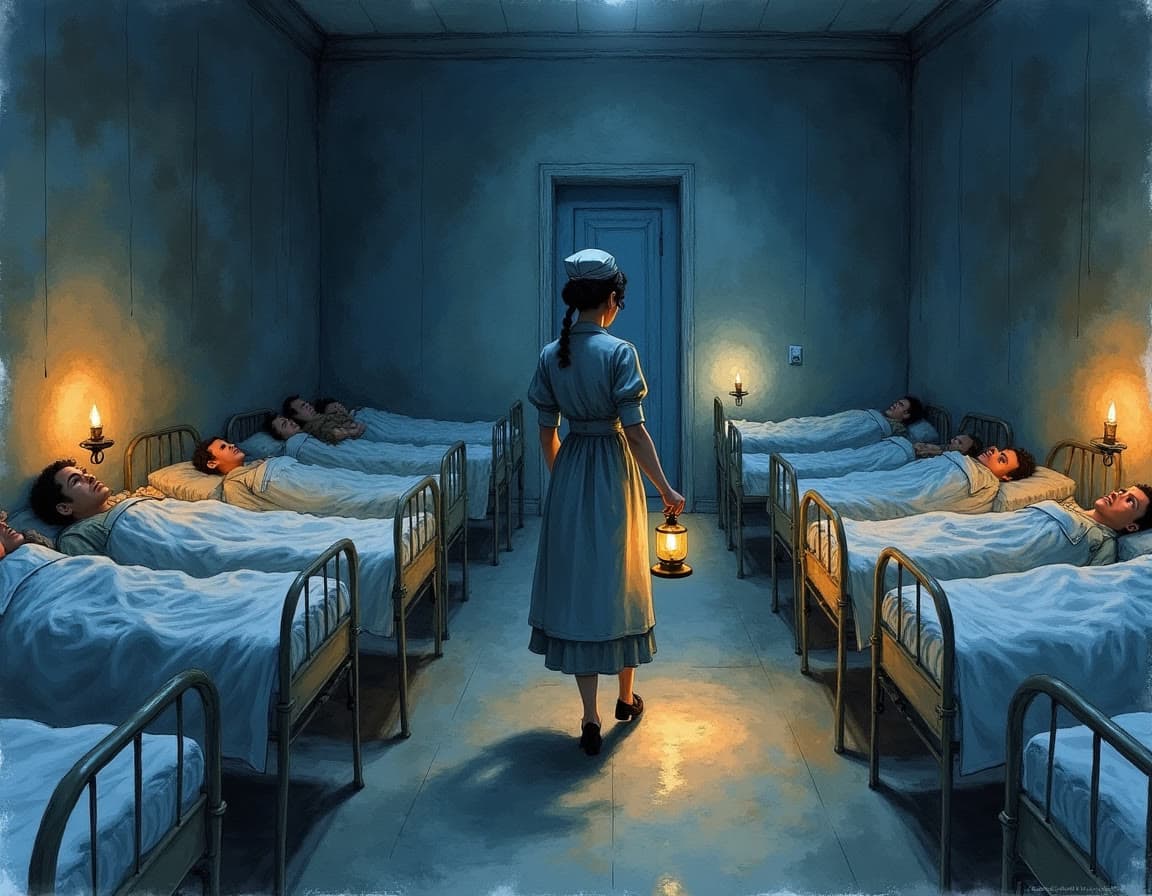
Soldiers profoundly admired Nightingale for her tireless dedication and her habit of personally walking through the hospital wards late at night, carrying a small lamp to check on patients even when she was utterly exhausted herself. This simple, humble image earned her the enduring nickname the Lady with the Lamp, and news of her extraordinary compassion soon spread throughout all of Britain.
第 9 段
Even before the war, Nightingale had defied her family's wishes by secretly studying nursing manuals and touring hospitals across Europe whenever she could arrange a pretext to travel. This largely self-directed education, unusual for a woman of her class, gave her a broad comparative understanding of hospital practices that few contemporaries, male or female, could match by the time war broke out.
第 10 段
After finally returning home from the war, Nightingale channeled her hard-won fame and considerable influence into ambitious systemic healthcare reform. She published influential, meticulously researched reports demonstrating conclusively that sanitation and proper hygiene practices dramatically reduced patient mortality, and in 1860, she established the very first formal, professional nursing school in the world at St Thomas' Hospital in London.
第 11 段
Nightingale was also a genuine pioneer in the emerging field of statistics, inventing an innovative circular diagram, later nicknamed the rose diagram, to vividly illustrate how preventable disease, rather than battlefield wounds, accounted for the overwhelming majority of soldier deaths. She understood, well ahead of her contemporaries, that compelling visual evidence could persuade skeptical officials far more effectively than dense written reports alone.
第 12 段
Her rigorous, evidence-based approach to healthcare fundamentally transformed nursing from a poorly regarded, informal occupation into a respected and increasingly professional discipline grounded firmly in careful scientific principles.
第 13 段
Nightingale's mother and elder sister reacted to her nursing ambitions with something close to despair, viewing the profession as scarcely more respectable for a woman of her social standing than common domestic service. For years, family gatherings grew tense whenever the subject arose, and Nightingale later described this prolonged domestic conflict as more emotionally exhausting than almost anything she subsequently endured on the battlefield itself.
第 14 段
The reforms Nightingale championed extended influence well beyond Britain's own borders. Her published findings and correspondence helped inspire the founding principles of the International Red Cross movement, and reformers in numerous other countries drew directly upon her meticulous statistical methods when campaigning for improved public health and sanitation standards within their own hospitals and growing cities.
第 15 段
Although chronic illness confined Nightingale largely to her home for much of her later life, she nevertheless continued writing and advocating tirelessly for healthcare reform for several more decades. When she died in 1910, at the remarkable age of ninety, she left behind an enduring legacy that permanently transformed nursing and hospital care throughout the entire world, a legacy that modern healthcare workers everywhere continue to honor to this very day.
第 16 段
Every year on Nightingale's birthday, nurses around the globe mark International Nurses Day, a fitting tribute to a woman who defied her own privileged family's expectations to build an entirely new profession from almost nothing. Her insistence that compassion and rigorous scientific evidence belong together, rather than in separate spheres, remains a guiding principle of modern medicine to this day.
第 17 段
As a young woman, Nightingale described experiencing what she later called a distinct calling from God, urging her toward a life of service, an experience that convinced her utterly of her chosen path even as virtually everyone around her insisted she was squandering a privileged and comfortable future for pointless, unbecoming labor.
第 18 段
Nightingale's insistence on rigorous cleanliness extended well beyond hospital wards into her broader writings on public health, in which she argued forcefully that poor sanitation in ordinary homes and city streets contributed just as significantly to widespread disease and premature death as it did within military hospitals, ideas that helped lay important groundwork for the modern public health movement.
南丁格尔:提灯天使与现代护理之母
Florence Nightingale was born in 1820 into a wealthy and highly cultured English family, one that expected her, like most young women of her privileged social class, to eventually marry well and quietly devote herself entirely to managing a comfortable and fashionable household.
本次阅读生字复习
你还没有收藏这本书的生字
点击内文中任何一个单字,按下「⭐️ 加入我的生字本」,读完后就会在这里出现复习卡片。