 第 1 册⚡ CEFR B2・中高级
《特斯拉》名人传记有声书全系列共 1 册
特斯拉:电流大战的天才发明家
Nikola Tesla: Genius of the War of Currents
带着几枚硬币移民美国的特斯拉,以交流电技术挑战爱迪生的直流电帝国,掀起著名的「电流大战」。他点亮了1893年世界博览会,驯服了尼加拉瀑布的电力,却在商业上屡屡受挫,晚年孤独地在旅馆房间里与鸽子为伴,直到身后才获得世人迟来的肯定。
CEFR B2・中高级⏱️ 约 9 分钟📝 1100 字
《特斯拉》名人传记有声书・第 1 册第 1 / 34 句
特斯拉:电流大战的天才发明家
Nikola Tesla: Genius of the War of Currents
0:00
故事全文(1/34)
字级
第 1 段
Nikola Tesla was born in 1856 in a small village in what is now Croatia, the son of a Serbian Orthodox priest. From an extraordinarily young age, Tesla displayed an almost supernatural memory and an intense, restless imagination, later claiming that he could visualize entire inventions in his mind with such vivid clarity that he barely needed to build physical prototypes at all.
第 2 段
As a young engineering student in Austria, Tesla became fascinated by the emerging field of electricity, particularly its most stubborn unsolved problem: how to convert electrical current efficiently over long distances. While walking through a park one afternoon, he later recalled, the solution suddenly flashed into his mind as a complete and fully formed vision, the foundation of what would become alternating current, or AC, technology.
第 3 段
In 1884, seeking greater opportunity, Tesla emigrated to the United States with little more than a letter of introduction to the famous inventor Thomas Edison, along with a handful of coins in his pocket. He initially found work at Edison's company, where his brilliance was quickly recognized, though the two men's personalities and philosophies of invention could scarcely have been more different.
第 4 段
Edison championed direct current, or DC, electricity and had already invested enormous sums of money in the infrastructure required to distribute it. Tesla, by contrast, was convinced that alternating current was vastly more efficient for transmitting electricity over long distances. Their disagreement escalated into a bitter and highly public rivalry that historians would later dub the War of the Currents.
第 5 段
Determined to convince the public that alternating current was unacceptably dangerous, Edison and his associates staged a series of gruesome public demonstrations in which stray animals were electrocuted using AC current, and he quietly encouraged the adoption of AC-powered electric chairs for state executions, hoping the public would forever associate the technology with death rather than progress.
第 6 段
After leaving Edison's company amid growing tension, Tesla partnered with the industrialist George Westinghouse, who shared his faith in alternating current and possessed the financial resources necessary to compete against Edison's formidable empire. Together, they secured the contract to illuminate the 1893 World's Fair in Chicago, a spectacular public triumph that helped convince the world of AC's practical superiority.
第 7 段
Tesla's crowning achievement came shortly afterward, when Westinghouse's company won the contract to harness the immense power of Niagara Falls using Tesla's alternating current system. The resulting power station, completed in 1895, was capable of transmitting electricity across vast distances, and it effectively settled the War of the Currents decisively in Tesla's favor, establishing AC as the worldwide standard that remains in use to this very day.
第 8 段
Beyond his transformative work with alternating current, Tesla was a prolific and endlessly curious inventor, holding hundreds of patents across his lifetime. He conducted pioneering experiments with radio transmission, remote control technology, and wireless communication, and he built an enormous experimental tower on Long Island in an ambitious, though ultimately unsuccessful, attempt to transmit electricity wirelessly across the entire globe.
第 9 段
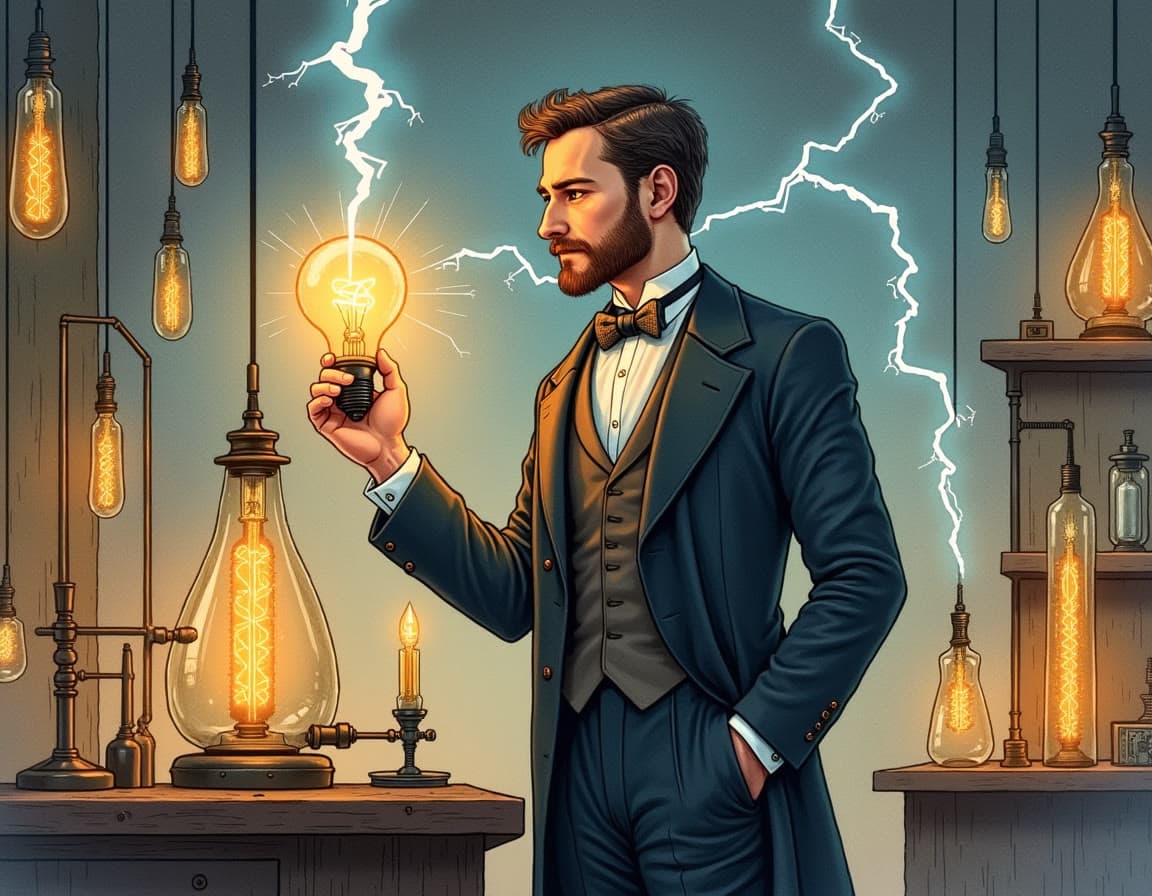
To dramatize the safety of alternating current amid Edison's aggressive public campaign to discredit it, Tesla staged sensational demonstrations in which he calmly passed high-frequency AC current directly through his own body, illuminating light bulbs he held in his bare hands while astonished crowds watched in disbelief, an early and remarkably effective form of scientific showmanship.
第 10 段
Tesla also found himself embroiled in a separate, protracted priority dispute with the Italian inventor Guglielmo Marconi over who had truly invented radio technology. Although Marconi received widespread public credit and even a Nobel Prize for early radio transmission, the United States Supreme Court eventually ruled, several months after Tesla's death, that his own foundational patents had actually preceded Marconi's.
第 11 段
Unfortunately, Tesla proved far more gifted as an inventor than as a businessman. He frequently struggled to secure sufficient funding for his increasingly ambitious projects, and several of his most visionary ideas were abandoned or lost entirely when investors grew impatient or lost confidence in projects that seemed, to more conventional minds, wildly impractical.
第 12 段
Even as a student in Austria, Tesla had displayed unusual intensity, reportedly studying so obsessively that he suffered a severe nervous collapse and was warned by physicians that continued overwork might permanently damage his health. Rather than moderating his habits, he simply pushed forward with even greater determination once he had recovered, a pattern of relentless self-driven effort that would define his entire career.
第 13 段
Colleagues who visited Tesla's laboratory frequently described witnessing genuinely astonishing demonstrations, including a small remote-controlled boat he unveiled in 1898, which audiences found so bewildering that some accused him of secretly controlling it through telepathy, unable to conceive of any more rational explanation for wireless control at such an early date.
第 14 段
As he aged, Tesla grew increasingly eccentric and reclusive, developing peculiar habits and obsessive fears that alienated many of his former colleagues and admirers. He spent his final years living alone in a New York hotel room, forming an unusually close attachment to the pigeons he fed daily in nearby city parks, and he died in relative poverty and obscurity in 1943.
第 15 段
It took several decades for the wider world to fully appreciate the staggering scope of Tesla's genius. Today, he is celebrated as one of history's most visionary inventors, and his contributions to electrical engineering, wireless technology, and renewable energy continue to influence modern science profoundly. In a fitting tribute to his enduring legacy, the unit measuring magnetic flux density, along with an electric car company that bears his name, now carry his memory forward into the twenty-first century and beyond.
第 16 段
Modern technologies that Tesla could scarcely have imagined in concrete detail, including wireless phone charging and increasingly efficient renewable power grids, nevertheless trace their conceptual roots directly back to his tireless experimentation. His story continues to resonate powerfully with inventors and dreamers who feel that the world around them has not yet caught up with their own restless imagination.
第 17 段
Tesla's early education in Austria exposed him to some of the era's most advanced engineering instruction, yet he never actually completed his degree, leaving the institution abruptly after a personal crisis brought on by relentless overwork and a subsequent, temporary loss of confidence in his own abilities as a student.
第 18 段
Tesla's rivalry with Edison was as much a clash of temperament as of technology. Edison famously favored relentless trial and error, testing thousands of materials in search of a workable solution, while Tesla insisted he could visualize an entire working device in his mind before ever touching a single physical component, a contrast the two men themselves often highlighted whenever journalists asked them to compare their very different working methods.
特斯拉:电流大战的天才发明家
Nikola Tesla was born in 1856 in a small village in what is now Croatia, the son of a Serbian Orthodox priest.
本次阅读生字复习
你还没有收藏这本书的生字
点击内文中任何一个单字,按下「⭐️ 加入我的生字本」,读完后就会在这里出现复习卡片。