 Book 3🌱 CEFR A1・Beginner
The Ugly Duckling — Graded Audiobook Series3 books in this series
The Beautiful Swan
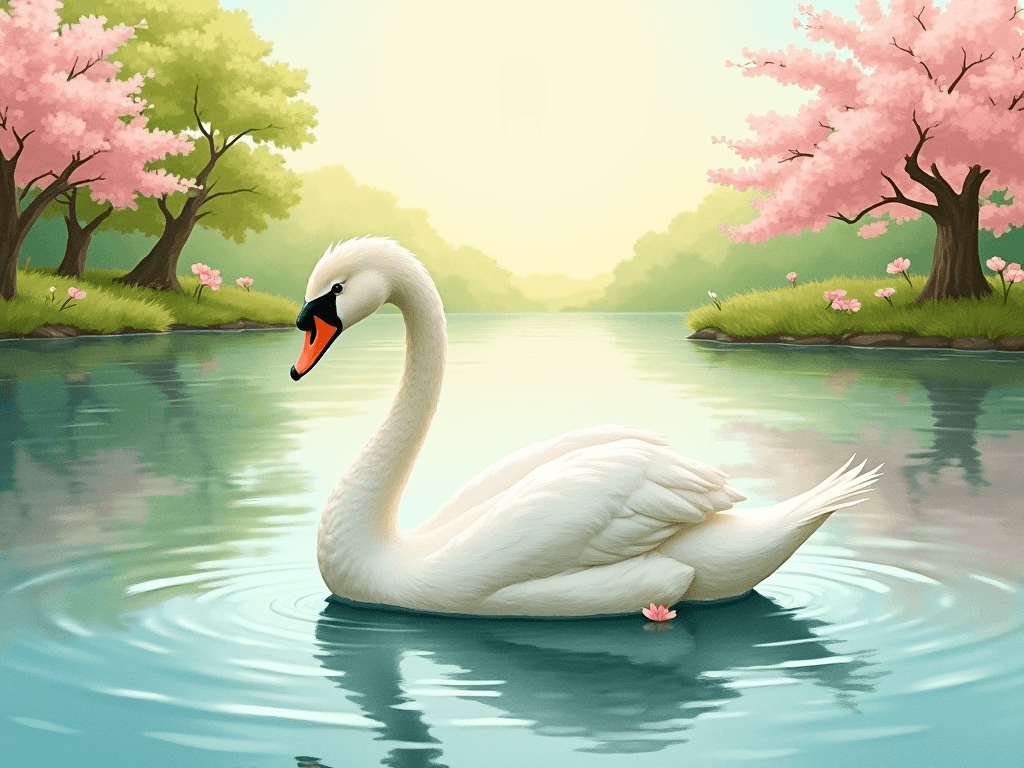
Spring returns and the ice melts. The ugly duckling gathers the courage to swim toward a flock of graceful swans — and is astonished by his reflection in the clear water: he is no longer a gray, ugly duckling, but a beautiful white swan.
CEFR A1・Beginner⏱️ ~10 min📝 1348 words
The Ugly Duckling — Graded Audiobook Series・Book 3
The Beautiful Swan
0:00
Full story
Text size
Paragraph 1
Spring came slowly. The ice on the river broke up and the water flowed again. Green plants appeared everywhere. Birds came back from the warm south. The air became soft and sweet. The duckling felt new strength in its body. It opened its wings wide and flew up into the sky. It felt the warm spring air around it. Its wings were much larger now than they had been in autumn. The duckling had grown a great deal over the long cold winter. Now it flew high and free above the river and the fields.
Paragraph 2
The duckling flew over a wide, beautiful lake. Below it, it could see clear blue water and green trees around the edge of the water. The lake looked peaceful and lovely. The duckling flew down and landed on the water. It swam slowly, looking around. The lake was quiet. Flowers grew at the edge of the water. The sun shone on the lake and made everything bright and warm. For the first time in a very long time, the duckling felt something close to happiness. "This is a nice place," it thought. "I would like to stay here."
Paragraph 3
As the duckling swam near the edge of the lake, it saw a group of large white birds on the water. They were the same kind of birds it had seen flying south in autumn. They swam slowly and easily on the water. Their long white necks moved in beautiful shapes. The duckling's heart beat very fast. It wanted to swim toward them, but it was afraid. "They will laugh at me," it thought. "They will say I am ugly and swim away. That is what always happens with me."
Paragraph 4
But something stronger than fear pushed the duckling toward the white birds. It swam slowly in their direction. "If they chase me away," it thought, "I will be no more alone than I already am." It swam closer and closer. The white birds turned to look at it. The duckling looked down, waiting to hear the old words — ugly, wrong, go away. But something happened that it had never expected. The white birds swam toward it. They called out to it in soft, kind voices. They were not chasing it away.
Paragraph 5
The duckling was so surprised that it almost stopped swimming. But the white birds were friendly and kind. They swam around it and put their heads down low in a greeting. One older bird swam close and looked at the duckling carefully. "Where did you come from?" it asked. "I have been alone," said the duckling. "I have been alone for a very long time." The older bird nodded slowly. "Yes," it said. "I can see that. But you are not alone now. You are here with us. You are safe."
Paragraph 6
"With you?" the duckling said. "But I am ugly. Everyone has always said so." The white birds all looked at each other. One of them pointed its beak toward the still water. "Look down," it said. The duckling looked down at the lake. And it saw its own face for the first time clearly. It was not the gray, rough, ugly bird it had always been. Looking back at it from the water was a large, beautiful white bird with a long, soft neck and bright white feathers. It was a swan. It had always been a swan.
Paragraph 7
The young swan stared at its face in the water for a long time. It could not believe what it saw. "That is me?" it asked. "That is you," said the older bird kindly. "You were always one of us. We are swans. You are a swan too. You hatched in the wrong nest. You grew up among ducks. But that does not change what you really are." The young swan looked at its white wings and its long neck. It had never seen itself clearly before. It had never known. All this time, it had been a swan.
Paragraph 8
Just then, some children came running to the edge of the lake. They had bread to throw to the birds. They stopped and stared at the swans. "Look!" one girl said. "There are swans on the lake!" A boy pointed at the young swan. "That one is the most beautiful!" he said. "Look at its long neck! Look at how white it is!" The young swan heard the children's words and felt something warm fill its chest. It was not pain. It was not sadness. It was joy. Real joy. It had not felt joy in a very long time.
Paragraph 9
An old man who was walking by stopped to look at the swans. "What a beautiful group," he said. He looked at the young swan for a long time. "That one is especially lovely," he said quietly. "I have never seen a swan quite like it." The young swan put its head down and swam close to the bank. A little girl held out a piece of bread, and the young swan ate from her hand. The girl laughed with happiness. "It is so friendly!" she said. The young swan was not afraid. These people were kind, and kindness felt like home.
Paragraph 10
That night, the young swan rested on the quiet lake with the other swans around it. The stars were bright above, and the water was still and dark. The young swan looked up at the sky. It thought about the farm and the pond where it was born. It thought about the cold winter and the long nights alone in the snow. It thought about all the times it had been pushed away and called ugly. All of that pain felt very far away now. Like a bad dream from another life.
Paragraph 11
The young swan did not feel angry about the past. It felt sad for the young duck it had been — that small, lost animal that had never known what it really was. If someone had looked carefully, they might have seen the swan from the beginning. But no one had. And so it had been alone and in pain for so long. But that was over now. The young swan was home. Not a home of walls or a roof, but a home of belonging. For the first time in its life, it was with its own kind.
Paragraph 12
In the days that followed, the young swan learned to live among its family. The older swans taught it things. They showed it how to dive deep into the water to find food. They showed it the best parts of the lake. They swam together in the mornings and rested in the warm afternoons. The young swan ate well and felt stronger every day. Its feathers became more white and nice. Its neck grew long and straight. It was happy. It had not known what happy really felt like before now. Now it knew.
Paragraph 13
People came to the lake often to see the swans. The children from nearby learned to know the young swan because it was so beautiful. The young swan would swim toward them when they came. It liked people now. That had not always been true. But these people did not call it ugly. They said kind words. They smiled. The young swan thought about how different the world could feel depending on whether the people in it were kind or cruel. Kindness made everything different. Kindness made life worth living.
Paragraph 14
Summer came, and the lake was full of life. Green plants grew thick at the edges. Small fish moved through the clear water. Frogs sang in the evenings. The young swan swam on the lake every day, feeling the sun on its white feathers and the cool water around its feet. It thought of the words the old swan had said: "You were always one of us." That was true. It had always been a swan. It had just not known it. Now it knew. And knowing made all the difference. The ugly duckling was gone. In its place, a beautiful swan opened its wings wide and was finally free.
The Beautiful Swan
Tap to play the audiobook
Auto-playing next book(5s)
The Emperor's New Clothes — Graded Audiobook Series · Book 1: The Vain King and Two Weavers
The Ugly Duckling — Graded Audiobook Series — all books
Vocabulary from this book
You haven't saved any words from this book yet
Tap any word in the story and hit "⭐️ Save to my vocabulary" — review cards will show up here once you finish.