 Book 2🌱 CEFR A1・Beginner
The Ugly Duckling — Graded Audiobook Series3 books in this series
The Long Winter
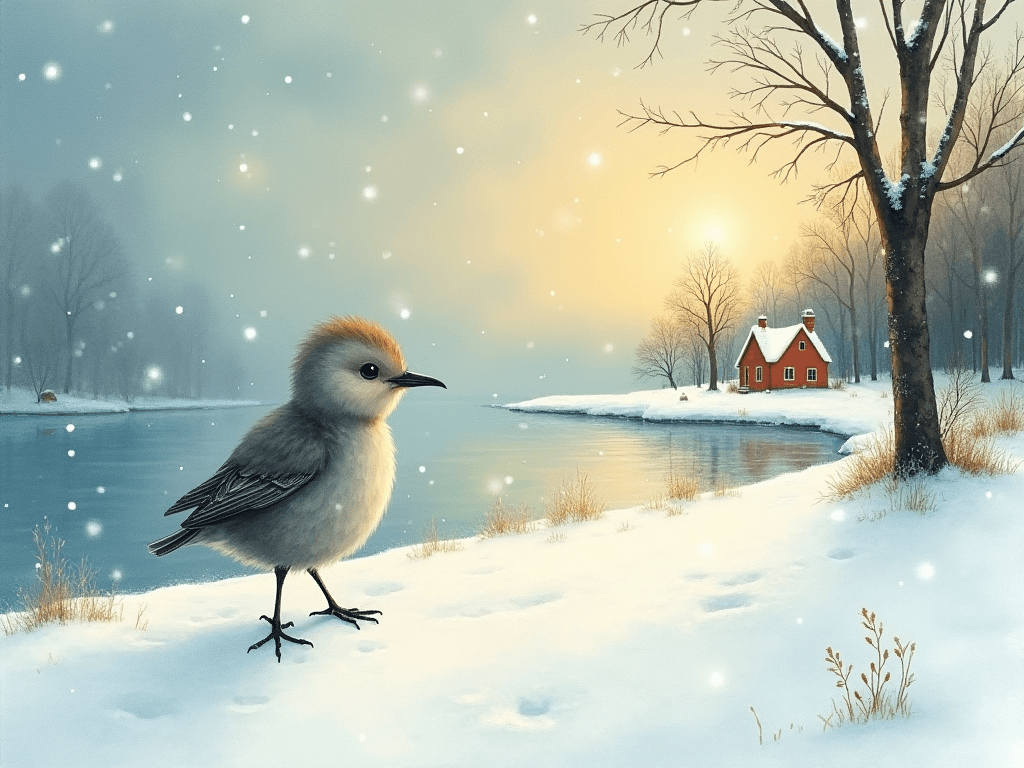
Winter arrives and the lake freezes over. The ugly duckling is turned away at an old woman's cottage and gets trapped in the icy water. A farmer saves him, but he flees again into the snow, struggling to survive the long, cold nights.
CEFR A1・Beginner⏱️ ~10 min📝 1320 words
The Ugly Duckling — Graded Audiobook Series・Book 2
The Long Winter
0:00
Full story
Text size
Paragraph 1
Winter came quickly that year. The air turned cold and sharp, and the edges of the lake began to turn hard with ice. The duckling swam in the middle of the water to keep warm, but every morning, the ice reached a little farther out. It found less and less food each day. The trees had no leaves, and the sky was gray most days. The duckling had never felt so cold. Its feathers helped a little, but not enough on the coldest nights. It shook in the dark.
Paragraph 2
One day, the duckling saw an old farmhouse near the lake. Through the small window, it could see warm light inside. It walked up slowly and knocked on the door with its beak. The old woman who lived there opened the door. She was not wearing her glasses, so she could not see well. "Oh," she said, "a big bird. You can come in." The duckling walked inside. It was warm. The duckling felt much better. Sitting near the warm fire were a fat hen and a black cat.
Paragraph 3
The old woman gave the duckling some food and water. "You can stay here," she said. "Maybe you will lay eggs for me." But the duckling did not lay eggs. Day after day, the old woman waited. The hen looked at the duckling and said, "Can you lay eggs?" "No," said the duckling. "Then what use are you here?" said the hen. The black cat also looked at it. "Can you catch mice?" the cat asked. "No," said the duckling. "Can you make a sound like a cat?" "No," said the duckling. The cat turned away.
Paragraph 4
Life in the farmhouse was not kind. The hen and the cat did not talk to the duckling. They talked to each other and left the duckling alone in the corner. "It is not useful," said the cat. "It does not belong here," said the hen. The duckling sat in its corner and missed the open water and the wide sky. It missed swimming. It missed the feeling of cold water around its legs. The house was warm, but the duckling felt sad inside. It was with others, and yet it was just as alone as before.
Paragraph 5
One morning, the duckling could not wait any longer. It walked to the door and went outside. The world was covered in white snow. The air was very cold, but the duckling felt free. It walked through the snow until it found the lake again. Most of the water was now hard with ice. But there was still a small open area in the middle. The duckling jumped in and swam in circles to keep warm. The cold water made it shake, but at least it was outside. At least it was free.
Paragraph 6
The days grew shorter and the nights grew longer. It became almost too cold to stay alive. The duckling swam in the small area of open water every day. One evening, the open water began to close. The ice moved in from all sides. The duckling swam faster and faster, trying to keep the water open, but it was too tired. The ice closed around it. Its feet were stuck. It could not move. It shook and shook, but nothing helped. The sky above was dark and the stars were cold and far away.
Paragraph 7
The next morning, a farmer walked past the lake. He saw the duckling stuck in the ice. "Poor thing," the farmer said. He walked onto the ice carefully and broke it with his boot. Then he picked up the cold, shaking duckling and put it inside his coat to keep it warm. He carried it home to his family. His wife was surprised, but she made a warm corner in the kitchen for the duckling. The children were excited to see the big bird. They wanted to touch it and play with it.
Paragraph 8
But the children ran toward the duckling too fast. It was afraid. It jumped up and knocked over a bowl of milk. Then it ran into a bag of flour and got covered in white flour. The farmer's wife ran after it with a broom. The duckling ran to the door and flew out into the cold air. It could hear the children laughing and the farmer's wife shouting. The duckling flew away as fast as its wings could carry it, with white flour falling into the cold air behind it.
Paragraph 9
It flew until it was too tired to fly. It landed in a field of dry grass and tall plants near a small river. It hid among the tall grass and tried to rest. Snow was falling lightly. The duckling sat very still and listened to the quiet. A small bird flew past and said nothing. An old rabbit walked by in the snow and did not stop. The duckling ate some old seeds it found on the ground and tried not to think about the cold. It was very thin now. But it was still alive.
Paragraph 10
Days and nights passed. The duckling did not move much. It was too cold and too tired to go far. It ate what little it could find. Some days, it found no food at all. It grew thin and weak. But each morning, it opened its eyes and looked at the gray sky. "Why am I still here?" it thought. "What is the point of going on?" But then the sun would come out for a moment and warm its feathers, and it would think again: "Maybe tomorrow will be better." And so it stayed alive, one day at a time.
Paragraph 11
After many long weeks, the duckling began to notice small changes. The days were a tiny bit longer. The snow was a little less deep each morning. A few green plants appeared at the edge of the river. The duckling ate the small green plants and felt a little stronger. It walked to the river and swam in the cold water. Its legs were weak, but they still worked. It swam slowly from one bank to the other. "I am still alive," it thought. It was a small thing, but it felt like something good.
Paragraph 12
One morning, the duckling looked down at its face in the river water. It saw something unexpected. What it saw in the water did not look like the ugly gray bird it had always been. Its neck was much longer now. Its feathers were better. Its body looked different from before. It looked at itself for a long time. But it was afraid to believe what it was seeing. It had been called ugly for so long. Surely this was just the light playing tricks. It was still the same ugly duckling. It must be.
Paragraph 13
Then it heard a sound in the sky. It looked up and saw a group of large white birds flying over the river. They had long, beautiful necks and bright white feathers. The duckling had seen birds like these in autumn, flying south. Now they were coming back. That meant spring was near. The duckling watched them fly past. The sight of them filled its chest with a feeling it could not explain. It was not sadness. It was not pain. It was something warm and new. Like a door beginning to open.
Paragraph 14
The duckling did not know what the feeling was. But it stayed with it. As the river water moved on and the ice continued to break up, the duckling felt something growing inside it. It was hope. A small, careful hope. After all the cold and the pain and the long nights alone, something was different now. Spring was coming. And the duckling — thin and tired and still alone — decided to keep going. It would keep swimming and see what spring would bring. It did not know what was waiting. But it was going to find out.
The Long Winter
Tap to play the audiobook
Auto-playing next book(5s)
The Ugly Duckling — Graded Audiobook Series · Book 3: The Beautiful Swan
The Ugly Duckling — Graded Audiobook Series — all books
Vocabulary from this book
You haven't saved any words from this book yet
Tap any word in the story and hit "⭐️ Save to my vocabulary" — review cards will show up here once you finish.