 Book 1⚡ CEFR B2・Upper-Intermediate
Charles Darwin — Graded Biography Series1 books in this series
Charles Darwin: On the Origin of Species
Once dismissed by his own father as aimless, young Charles Darwin joined a five-year voyage aboard HMS Beagle. Subtle differences among Galápagos finches planted the first seeds of doubt about fixed species — doubts that, decades later, blossomed into On the Origin of Species and forever changed how humanity understands life itself.
CEFR B2・Upper-Intermediate⏱️ ~9 min📝 1117 words
Charles Darwin — Graded Biography Series・Book 1Sentence 1 / 36
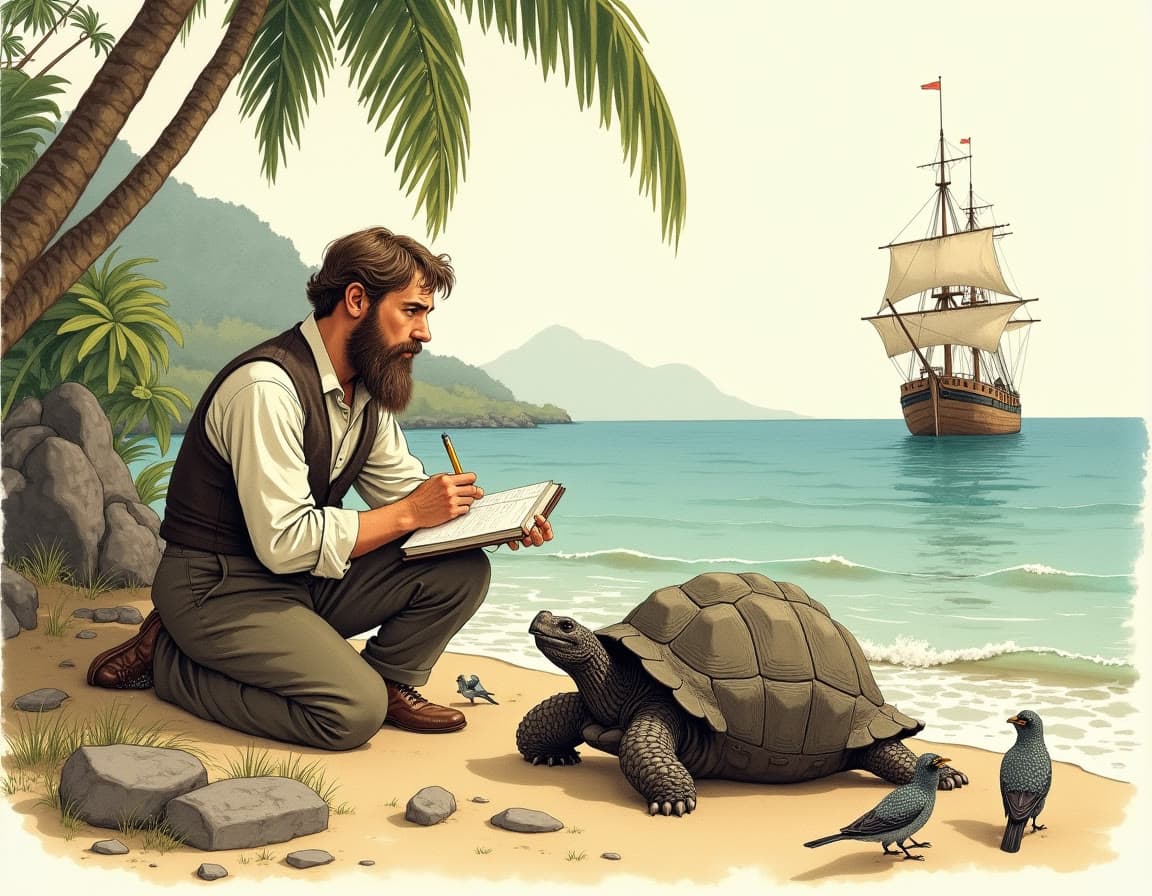
Charles Darwin: On the Origin of Species
0:00
Full story(1/36)
Text size
Paragraph 1
Charles Darwin was hardly the sort of person anyone expected to overturn centuries of accepted belief about the origins of life on Earth. Born in 1809 into a wealthy and comfortable English family, he was, by his own admission, an unremarkable student who found formal schooling tedious and much preferred wandering outdoors, collecting beetles, and observing the natural world with quiet fascination.
Paragraph 2
His father, a successful physician, was deeply disappointed by his son's apparent lack of ambition and famously complained that Charles cared for nothing but shooting, dogs, and rat-catching, gloomily predicting that he would grow up to disgrace himself and his entire family. Hoping to steer him toward a respectable profession, his father sent him first to study medicine in Edinburgh, and later theology at Cambridge, though Darwin's genuine passions remained firmly rooted in natural history.
Paragraph 3
It is a remarkable irony of history that this same supposedly disgraceful young man would one day be buried among Britain's most celebrated national heroes, a fact that speaks volumes about how poorly conventional academic performance can sometimes predict a person's true and lasting contribution to human knowledge.
Paragraph 4
Everything changed in 1831, when a former professor recommended the twenty-two-year-old Darwin for an unpaid position as a naturalist aboard the HMS Beagle, a naval survey ship about to embark on an ambitious five-year voyage around the world. His father initially forbade the trip, considering it a reckless waste of time, but eventually relented after Darwin's uncle intervened on his behalf.
Paragraph 5
The voyage of the Beagle would transform Darwin from an aimless young gentleman into one of history's most meticulous and observant scientists. As the ship sailed along the coasts of South America, he collected thousands of specimens, examined fossils of extinct giant mammals, and witnessed firsthand the staggering diversity of life inhabiting different environments across the globe.
Paragraph 6
Darwin also observed that giant tortoises living on different Galápagos islands could be reliably distinguished by the distinctive shape of their shells, with local sailors reportedly able to identify a tortoise's home island simply by glancing at its silhouette. Such small but consistent variations between neighboring populations gradually convinced him that species were far less fixed and unchanging than prevailing scientific opinion had long assumed.
Paragraph 7
Nowhere did his observations prove more consequential than on the remote Galápagos Islands, off the coast of Ecuador. There, Darwin noticed that finches on different islands possessed subtly different beak shapes, seemingly adapted to the particular foods available on each island. This puzzling pattern planted a seed of doubt in his mind about the prevailing belief that all species had been created in their present, unchanging form.
Paragraph 8
After returning to England in 1836, Darwin spent more than twenty years quietly developing his revolutionary theory, gathering an overwhelming body of evidence and testing his ideas with obsessive rigor before daring to publish anything. He understood all too well how controversial and potentially explosive his conclusions would be, since they directly challenged deeply held religious convictions about the special creation of humankind.
Paragraph 9
What ultimately forced his hand was a letter from another naturalist, Alfred Russel Wallace, who had independently arrived at strikingly similar conclusions while working in Southeast Asia. Rather than compete bitterly for credit, the two men agreed to present their ideas jointly to the scientific community, and Darwin finally rushed to complete his life's work.
Paragraph 10
In 1859, Darwin published On the Origin of Species, a book that would permanently alter humanity's understanding of its own place in nature. In it, he argued that all living species had gradually evolved over immense spans of time through a process he called natural selection, whereby organisms best suited to their environment were more likely to survive and reproduce, passing their advantageous traits on to future generations.
Paragraph 11
Darwin's personal life during these decades was inseparable from his scientific work. He married his cousin Emma Wedgwood in 1839, and the couple eventually raised ten children together, though Darwin was tormented by chronic, mysterious illness for most of his adult life, likely worsened by the crushing anxiety of harboring such a controversial and unfinished theory for so many years.
Paragraph 12
The devastating loss of his beloved ten-year-old daughter Annie in 1851 profoundly deepened Darwin's private doubts about traditional religious explanations for suffering in the natural world, and many biographers believe this personal tragedy further steeled his resolve to pursue scientific truth wherever the evidence honestly led, regardless of its uncomfortable theological implications.
Paragraph 13
The book provoked immediate and fierce controversy. Members of the clergy denounced it from the pulpit, satirical cartoonists mocked Darwin mercilessly by depicting him with an ape's body, and many scientists of the era dismissed his theory outright. Despite the uproar, however, an ever-growing number of naturalists gradually recognized the overwhelming strength of his evidence and reasoning.
Paragraph 14
Darwin was not entirely alone in developing his controversial theory of natural selection. A younger naturalist named Alfred Russel Wallace, working independently in the remote islands of Southeast Asia, had reached remarkably similar conclusions through his own separate observations of tropical wildlife, and the two men's parallel discoveries were formally presented together to the scientific community in 1858.
Paragraph 15
Darwin himself, painfully shy and averse to public confrontation, relied heavily on a small circle of devoted allies to defend his theory in the fierce public arena. Chief among them was the biologist Thomas Huxley, whose combative debating skill and fearless advocacy earned him the enduring nickname Darwin's bulldog, a fitting title for someone who fought so tirelessly on behalf of a friend too reserved to fight for himself.
Paragraph 16
Beyond his most famous work, Darwin continued conducting patient, meticulous research for decades afterward, publishing detailed studies on subjects as varied as the fertilization of orchids, the surprising intelligence of earthworms, and the striking similarities between human and animal emotional expression, each new study quietly reinforcing the broader implications of his revolutionary theory.
Paragraph 17
Darwin spent his remaining years continuing his research from his quiet country home, largely avoiding public confrontation while allowing others to defend his ideas in fierce public debates. When he died in 1882, the controversy surrounding his theory had softened considerably, and he was honored with burial in Westminster Abbey. Today, the theory of evolution by natural selection stands as one of the most thoroughly validated and foundational principles in all of biological science, a monument to what patient, painstaking observation can ultimately achieve.
Paragraph 18
Modern genetics, a field entirely unknown during Darwin's own lifetime, has since provided overwhelming molecular confirmation of the very mechanisms he could only infer through careful, external observation. Every branch of biology today, from medicine to agriculture to conservation, rests upon evolutionary principles that Darwin first outlined using nothing more sophisticated than a notebook, a keen eye, and an extraordinary reservoir of patience.
Charles Darwin: On the Origin of Species
Charles Darwin was hardly the sort of person anyone expected to overturn centuries of accepted belief about the origins of life on Earth.
Vocabulary from this book
You haven't saved any words from this book yet
Tap any word in the story and hit "⭐️ Save to my vocabulary" — review cards will show up here once you finish.