 第 1 册⚡ CEFR B2・中高级
《牛顿》名人传记有声书全系列共 1 册
牛顿:从孤独男孩到万有引力
Isaac Newton: From Lonely Boy to Universal Gravitation
早产、丧父、被迫离开学校种田——年幼的牛顿看似与伟大科学家的形象相去甚远。然而正是在剑桥因瘟疫关闭、被迫隐居乡间的两年间,他奠定了微积分、光学与万有引力理论的基础,最终成为彻底改写人类宇宙观的科学巨人。
CEFR B2・中高级⏱️ 约 9 分钟📝 1178 字
《牛顿》名人传记有声书・第 1 册第 1 / 40 句
牛顿:从孤独男孩到万有引力
Isaac Newton: From Lonely Boy to Universal Gravitation
0:00
故事全文(1/40)
字级
第 1 段
In the winter of 1642, in a small farmhouse in Lincolnshire, England, a fragile baby was born so prematurely that few people expected him to survive the night. That baby, Isaac Newton, would eventually become one of the most influential scientists in human history, a man whose ideas would reshape our understanding of the physical universe for centuries to come.
第 2 段
Newton's childhood was far from happy. His father had died before he was born, and when his mother remarried, young Isaac was left in the care of his grandmother while his parents started a new family elsewhere. Lonely and withdrawn, he threw himself into building mechanical toys, sundials, and model windmills, revealing an early fascination with how things worked that would define the rest of his life.
第 3 段
When his mother eventually returned home after her second husband's death, she attempted to pull Newton out of grammar school entirely, insisting he learn to manage the family estate instead of continuing his formal education. Newton, by every account, proved a thoroughly hopeless farmer, reportedly allowing livestock to wander freely into neighboring fields while he sat absorbed in a book, oblivious to his supposed agricultural duties.
第 4 段
Despite his mother's insistence that he abandon his studies to manage the family farm, Newton's uncle recognized the boy's extraordinary intellect and persuaded her to send him to Cambridge University instead. It was there, however, that fate intervened in an unexpected way: in 1665, a devastating outbreak of plague forced the university to close its doors, and Newton retreated to his family's countryside home for nearly two years.
第 5 段
Rather than wasting this enforced isolation, Newton later described it as the most intellectually productive period of his entire life. Working alone, largely without guidance or supervision, he laid the foundations for calculus, conducted groundbreaking experiments with light and optics, and began formulating the theory of universal gravitation that would eventually make him famous throughout the world.
第 6 段
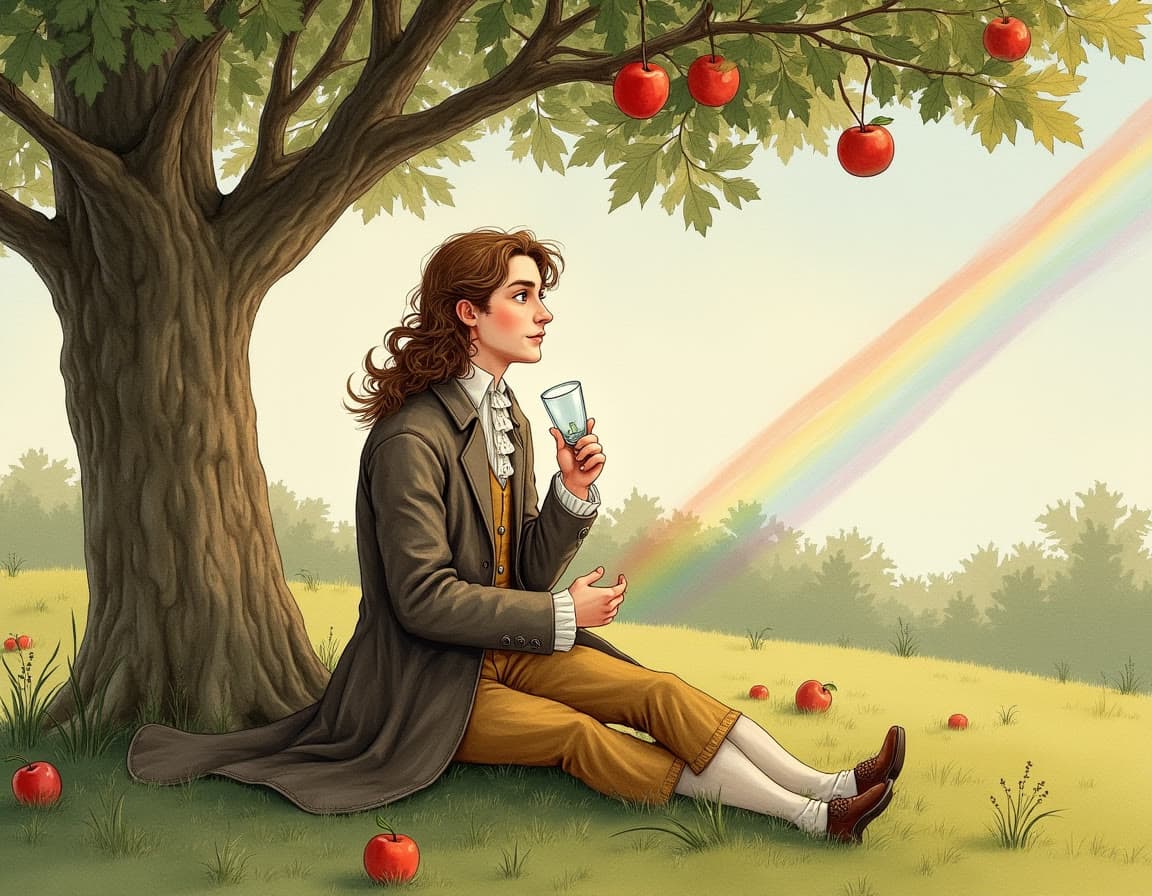
According to a widely repeated story, Newton's insight into gravity was triggered when he observed an apple falling from a tree in his garden. Whether or not this particular anecdote is entirely accurate, it captures something essential about his genius: an uncanny ability to perceive profound patterns hidden within seemingly ordinary events that everyone else had simply taken for granted.
第 7 段
When Cambridge finally reopened after the plague subsided, Newton returned and steadily rose through its academic ranks, eventually inheriting the prestigious Lucasian Chair of Mathematics from his own former teacher, Isaac Barrow, a position of considerable intellectual prestige that centuries later would also be held by the physicist Stephen Hawking.
第 8 段
It took Newton more than two decades to organize his scattered ideas into a coherent, publishable form. In 1687, urged on by fellow scientist Edmond Halley, he finally published his masterpiece, the Philosophiæ Naturalis Principia Mathematica, commonly known simply as the Principia. This monumental work established the three laws of motion and the law of universal gravitation, providing a mathematical framework that could explain everything from the trajectory of a cannonball to the orbits of distant planets.
第 9 段
Newton's personality, however, was notoriously difficult. He was intensely private, prone to bitter and prolonged disputes with rival scientists, and reluctant to publish his findings for fear of criticism. His long-running feud with the German mathematician Gottfried Leibniz over who had truly invented calculus consumed years of both men's lives and left a permanent stain on Newton's otherwise remarkable legacy.
第 10 段
Newton briefly served as a member of Parliament as well, though historical records suggest he contributed remarkably little to legislative debate. According to a frequently repeated anecdote, the only remark he ever made in the chamber was a polite request that an assistant close a drafty window, hardly the sort of oratory one might expect from such a towering intellectual figure.
第 11 段
Newton also devoted an enormous, largely private portion of his later life to theology and biblical chronology, painstakingly attempting to calculate precise dates for historical events described in scripture. Modern scholars examining his extensive private papers were genuinely astonished to discover that he had written far more on these religious and mystical subjects than on the physics and mathematics for which he remains celebrated today.
第 12 段
In his later years, Newton took on public responsibilities far removed from pure science. As Warden and later Master of the Royal Mint, he pursued counterfeiters with the same relentless determination he had once applied to scientific problems, personally interrogating suspects and helping to send several to the gallows. He was also elected President of the Royal Society, a position of considerable prestige that he held until his death.
第 13 段
Newton was knighted by Queen Anne in 1705, becoming Sir Isaac Newton, and he continued working almost until the very end of his life. When he died in 1727 at the age of eighty-four, he was given the extraordinary honor of a state funeral and was buried at Westminster Abbey, an honor typically reserved for kings, queens, and national heroes rather than scientists.
第 14 段
Long before the Principia established his reputation, Newton had already made revolutionary contributions to the study of light itself. By passing a beam of sunlight through a glass prism, he demonstrated that ordinary white light was, in fact, a composite mixture of every color in the visible spectrum, a discovery that fundamentally overturned centuries of accepted assumptions about the very nature of light and color.
第 15 段
Newton also harbored a secret passion that few of his contemporaries fully appreciated: alchemy, the ancient and largely discredited pursuit of transforming base metals into gold. He devoted thousands of hours to secretive chemical experiments and filled countless private notebooks with cryptic alchemical formulas, a curious pursuit that modern historians now regard as a genuine, if ultimately misguided, extension of his relentless scientific curiosity.
第 16 段
The dispute with Leibniz over calculus grew so venomous that Newton, exploiting his considerable influence as president of the Royal Society, arranged for a supposedly impartial committee to investigate the matter, then secretly wrote the committee's final report himself, unsurprisingly awarding himself full credit. Historians today generally agree that both men developed calculus independently, using strikingly different notation and methods.
第 17 段
Newton's influence on modern science is almost impossible to overstate. His laws of motion remained the standard framework of physics for more than two hundred years, until Albert Einstein's theories of relativity extended and refined them for extreme conditions Newton himself could never have imagined. Even today, his equations are precise enough to calculate the trajectories of spacecraft and satellites, a testament to the enduring power of a mind that transformed isolation and hardship into some of the greatest intellectual achievements the world has ever known.
第 18 段
Perhaps most remarkably, Newton himself remained genuinely humble about the true scope of his own achievements, reportedly remarking near the end of his life that he felt like a small child playing on a vast seashore, occasionally diverting himself by finding a smoother pebble or a prettier shell than usual, while the great ocean of undiscovered truth lay entirely undiscovered before him. That blend of towering genius and quiet humility continues to define how later generations of scientists remember him.
牛顿:从孤独男孩到万有引力
In the winter of 1642, in a small farmhouse in Lincolnshire, England, a fragile baby was born so prematurely that few people expected him to survive the night.
本次阅读生字复习
你还没有收藏这本书的生字
点击内文中任何一个单字,按下「⭐️ 加入我的生字本」,读完后就会在这里出现复习卡片。