 第 1 册⚡ CEFR B2・中高级
《梵谷》名人传记有声书全系列共 1 册
梵谷:燃烧的星夜与未竟的才华
Vincent van Gogh: The Burning Starry Night
梵谷生前仅卖出一幅画作,全靠弟弟提奥的支持才能持续创作。从阴郁的《食薯者》到灿烂的向日葵与星夜,他以浓烈色彩表达内心情感,却在三十七岁时结束自己的生命,直到身后才被世人公认为艺术史上最具影响力的画家之一。
CEFR B2・中高级⏱️ 约 9 分钟📝 1049 字
《梵谷》名人传记有声书・第 1 册第 1 / 33 句
梵谷:燃烧的星夜与未竟的才华
Vincent van Gogh: The Burning Starry Night
0:00
故事全文(1/33)
字级
第 1 段
Vincent van Gogh was born in 1853 in a small village in the Netherlands, the eldest surviving son of a Protestant minister. Restless, deeply sensitive, and prone to intense emotional swings throughout his entire life, the young Vincent drifted through a bewildering succession of jobs, including working as an art dealer and later attempting, with considerable religious fervor, to become a missionary among impoverished coal miners in Belgium.
第 2 段
Before turning seriously to painting, Vincent had passed through a fervent religious phase, working among impoverished coal miners in a bleak Belgian mining district and giving away most of his own modest possessions in an effort to live according to his intense, self-imposed interpretation of Christian charity. His religious superiors, uncomfortable with his extreme devotion, ultimately dismissed him from the missionary post entirely.
第 3 段
It was not until his late twenties, remarkably late for an artist who would eventually become so celebrated, that Vincent finally decided to seriously pursue painting. Encouraged and financially supported almost entirely by his devoted younger brother Theo, an art dealer living in Paris, he threw himself into intensive study with the same restless, almost desperate intensity that had characterized every other pursuit of his troubled life.
第 4 段
Van Gogh's earliest paintings were notably dark, somber, and heavily influenced by traditional Dutch masters, depicting humble peasants and laborers with considerable emotional sympathy and raw honesty. His painting titled The Potato Eaters, completed in 1885, exemplifies this early period, portraying a poor farming family gathered together for a simple, humble evening meal.
第 5 段
Everything changed dramatically when Vincent moved to Paris in 1886 to live with his brother Theo. There, he encountered the vibrant, revolutionary work of the Impressionist and Post-Impressionist painters, whose bold, unconventional use of color and expressive, energetic brushwork profoundly transformed his entire artistic approach and outlook.
第 6 段
Van Gogh worked at an almost unimaginable pace throughout his brief painting career, completing well over two thousand artworks, including roughly nine hundred paintings, in barely a single decade of active practice. He also produced dozens of searching self-portraits over the years, using his own reflection as a patient, always-available subject whenever he lacked the money to hire a professional model.
第 7 段
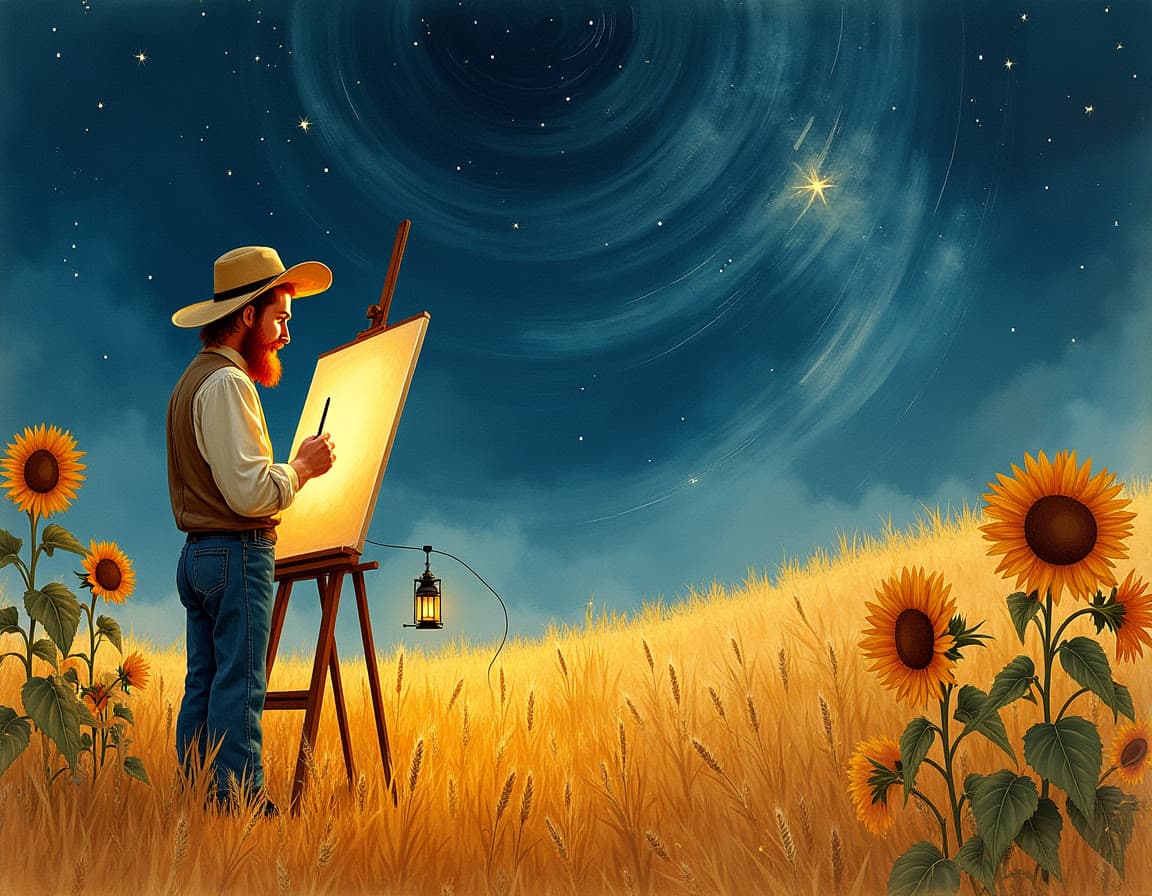
In 1888, seeking brighter light, warmer weather, and greater solitude, Van Gogh relocated to the sun-drenched town of Arles in southern France. There, he entered into what many art historians now regard as the most extraordinarily productive period of his entire career, producing an astonishing number of paintings within a remarkably compressed span of time, including his now-famous series of vivid, glowing sunflower paintings.
第 8 段
Throughout his entire adult life, Vincent maintained an extraordinarily rich and candid correspondence with his brother Theo, exchanging hundreds of letters filled with detailed discussion of technique, color theory, and his own turbulent emotional state. These deeply personal letters, preserved carefully after his death, now offer historians an unusually intimate window into the mind of a working artist.
第 9 段
Van Gogh's mental health, however, remained persistently fragile and increasingly precarious throughout this period. After a fierce and deeply distressing quarrel with fellow painter Paul Gauguin, who had briefly come to live and paint alongside him, Vincent suffered a severe psychological breakdown during which he famously severed part of his own ear with a razor.
第 10 段
Following this profoundly disturbing episode, Van Gogh voluntarily admitted himself to a psychiatric hospital in Saint-Rémy for extended treatment and care. Remarkably, even during this deeply difficult and turbulent period of his life, he continued painting with undiminished intensity, producing several of his most celebrated and beloved works, including the swirling, dreamlike night sky of The Starry Night.
第 11 段
Vincent's technique grew steadily bolder and more distinctive throughout this productive period, characterized by thick, richly textured layers of paint applied directly with the brush, and by his deliberate juxtaposition of vivid, contrasting colors placed side by side to create an almost vibrating visual intensity that photographs and reproductions still struggle to fully capture even today.
第 12 段
Tragically, despite his extraordinary and undeniable artistic talent, Van Gogh sold only a single painting during his entire lifetime and remained almost completely unrecognized by the wider art world. He depended almost entirely on his brother Theo's steady financial support and unwavering emotional encouragement, and the two brothers maintained an extensive, deeply moving correspondence that survives to this day.
第 13 段
In July of 1890, while living in the small French village of Auvers-sur-Oise, Van Gogh shot himself and died from his wounds two agonizing days later, at the tragically young age of just thirty-seven. He was buried in the local village cemetery, and his devoted brother Theo, utterly devastated by profound grief, died only six months afterward.
第 14 段
Theo's widow, Johanna van Gogh-Bonger, deserves considerable credit for Vincent's eventual posthumous fame. After her husband's death, she carefully organized and promoted the enormous collection of paintings and letters the two brothers had left behind, tirelessly arranging exhibitions across Europe and steadily building the reputation that had so cruelly eluded Vincent throughout his own difficult lifetime.
第 15 段
It was only in the decades following his tragic and untimely death that Van Gogh's genuine genius finally received the widespread recognition it had always deserved. Today, his vivid, emotionally powerful paintings are among the most beloved, reproduced, and valuable artworks in the entire world, and his extraordinary, deeply moving story continues to symbolize the profound and often heartbreaking relationship between artistic genius and personal suffering.
第 16 段
Museums exhibiting Van Gogh's work today routinely draw enormous crowds, and individual paintings that once could not find a single willing buyer now command staggering sums at international auction. The gap between his lonely, impoverished lifetime and his overwhelming posthumous fame remains one of the most poignant ironies in the entire history of Western art.
第 17 段
Vincent's distinctive artistic vocabulary, including his instantly recognizable swirling brushstrokes and his fearless use of intense, unmixed color, would go on to profoundly influence entire subsequent movements in modern art, from Expressionism to Fauvism, as later generations of painters openly acknowledged their considerable debt to his fearless example.
第 18 段
Vincent's relationship with color grew increasingly symbolic as his career progressed; he associated certain shades with specific emotional states, once explaining in a letter to Theo that he sought to use color more expressively than realistically, deliberately exaggerating hues to convey powerful feeling rather than simply recording the world exactly as his eyes perceived it in ordinary daylight.
梵谷:燃烧的星夜与未竟的才华
Vincent van Gogh was born in 1853 in a small village in the Netherlands, the eldest surviving son of a Protestant minister.
本次阅读生字复习
你还没有收藏这本书的生字
点击内文中任何一个单字,按下「⭐️ 加入我的生字本」,读完后就会在这里出现复习卡片。