 第 1 册⚡ CEFR B2・中高级
《孔子》名人传记有声书全系列共 1 册
孔子:周游列国的智者
Confucius: The Wandering Sage
生于战乱频仍的春秋时代,孔子幼年丧父、家境贫困,却靠着对学问的热爱自学成才。他周游列国十四年,寻求愿意采纳其仁政理想的君主,虽终生未能如愿,却透过有教无类的讲学,将思想化为《论语》,深刻影响东亚文化长达两千五百年。
CEFR B2・中高级⏱️ 约 9 分钟📝 1088 字
《孔子》名人传记有声书・第 1 册第 1 / 33 句
孔子:周游列国的智者
Confucius: The Wandering Sage
0:00
故事全文(1/33)
字级
第 1 段
Confucius was born around 551 BCE in the small state of Lu, located in what is now eastern China, during an era of near-constant warfare and political instability that historians now commonly refer to as the Spring and Autumn period. His father, reportedly an elderly military officer, died when Confucius was still merely a young child, leaving the family to endure considerable poverty and genuine hardship.
第 2 段
Despite these difficult early circumstances, Confucius developed an intense and lifelong passion for learning, particularly for the ancient rituals, classic texts, and cultural traditions of earlier Chinese dynasties. He held a variety of relatively modest government positions throughout his early career, gradually earning a solid reputation for scrupulous honesty, careful fairness, and remarkably sound practical judgment.
第 3 段
Central to his entire philosophy was the ideal of the junzi, often translated as the superior person or the true gentleman, someone who continuously cultivated moral virtue through disciplined self-reflection rather than someone who simply inherited noble rank or accumulated wealth by fortunate birth. Anyone, Confucius insisted, regardless of humble social origin, could aspire to become a junzi through sustained personal effort.
第 4 段
Confucius firmly believed that society's persistent troubles ultimately stemmed from a fundamental lack of proper moral cultivation among both individual people and their political rulers. He envisioned a harmonious, well-ordered society built upon core virtues including genuine benevolence, unwavering righteousness, appropriate propriety, and practical wisdom, values he believed could be actively taught and diligently cultivated through consistent education and disciplined self-reflection.
第 5 段
In his early fifties, Confucius briefly held a series of increasingly influential government positions in his home state of Lu, where he attempted, with mixed success, to put his political and ethical philosophy into genuine practice. When ongoing political conflicts eventually made his continued position there untenable, he made the difficult decision to leave, embarking on a long and often difficult journey across various Chinese states.
第 6 段
Confucius lived through the turbulent Spring and Autumn period, an era in which the once-powerful royal Zhou dynasty had grown weak and largely ceremonial, while numerous competing regional states waged near-constant war against one another for territory and influence. This pervasive instability profoundly shaped his lifelong preoccupation with restoring social order through ethical leadership rather than raw military force.
第 7 段
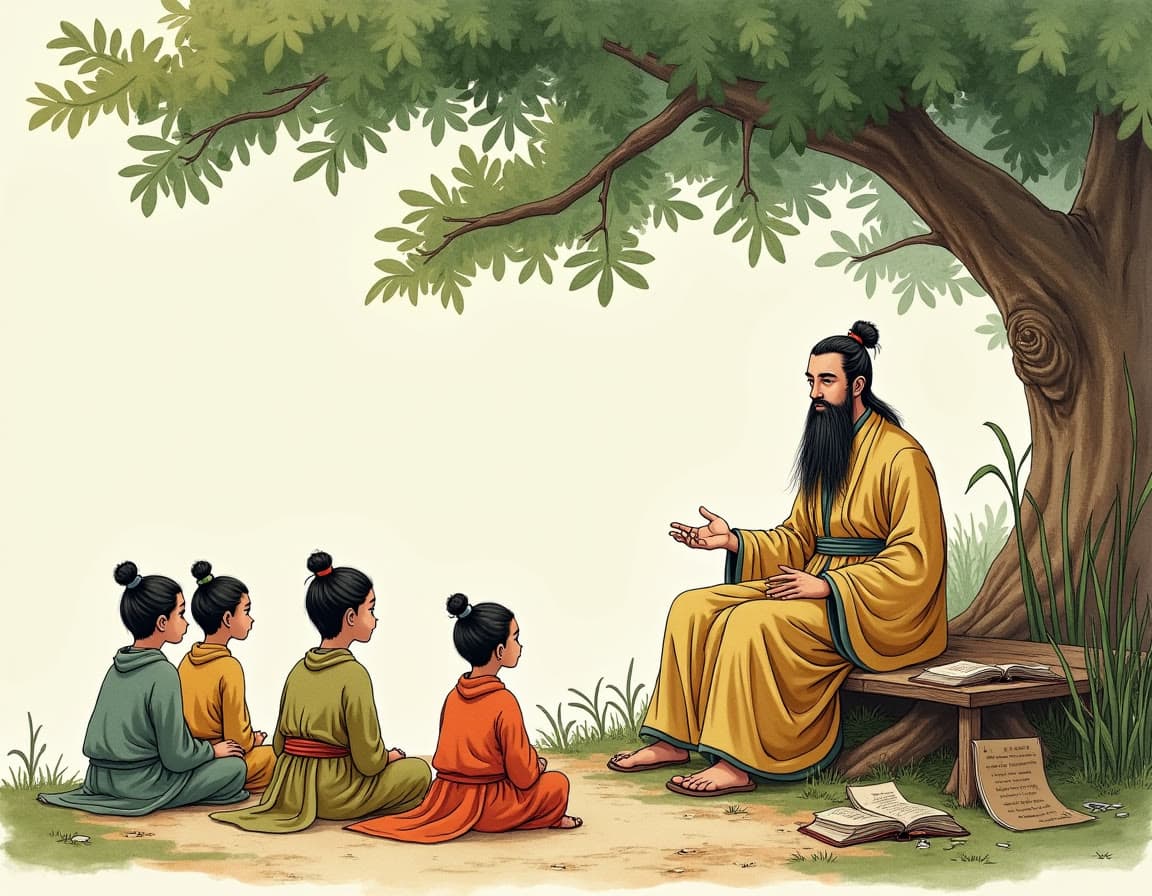
For roughly the next fourteen years, Confucius traveled extensively from state to state, accompanied by a small but devoted circle of loyal disciples, actively seeking a ruler genuinely receptive to his ambitious ideas about ethical governance. Although he was received with considerable respect in numerous royal courts, no ruler proved ultimately willing to fully adopt his demanding and comprehensive philosophical vision.
第 8 段
Undeterred by this persistent lack of direct political influence, Confucius poured his considerable energy into teaching instead, accepting students from a wide range of social backgrounds at a time when formal education was still generally reserved almost exclusively for the wealthy aristocracy. He firmly believed that genuine moral character mattered far more than inherited social status, a genuinely radical notion for his deeply hierarchical era.
第 9 段
Among his roughly three thousand students, tradition credits Confucius with seventy-two particularly accomplished disciples who mastered his teachings most fully. His favorite student, a quiet and remarkably virtuous young man named Yan Hui, died tragically young, and Confucius reportedly grieved his loss more intensely than that of almost anyone else in his entire life, including several of his own close relatives.
第 10 段
Confucius's distinctive teaching method relied heavily on carefully structured dialogue, thoughtful questioning, and memorable, easily digestible aphorisms rather than lengthy, formal lectures. He consistently encouraged his students to think deeply and independently for themselves, famously remarking that he would not repeat a lesson to any student unwilling to first genuinely try working out the answer on their own.
第 11 段
Among Confucius's most enduring teachings was the so-called Golden Rule, the simple but profound principle of never imposing upon others what one would not wish imposed upon oneself. He similarly emphasized filial piety, or deep respect and care for one's parents and elders, viewing the harmonious family as the essential foundation upon which a stable, ethical society must ultimately be built.
第 12 段
Confucius himself never personally wrote down his own teachings during his lifetime. Instead, his devoted students carefully compiled his memorable sayings and conversations after his death into a collection now known as the Analects, a relatively brief but extraordinarily influential text that continues to be studied intensively throughout China and much of East Asia to this very day.
第 13 段
Confucius died around 479 BCE, having never witnessed the ruler he had long hoped for, one genuinely willing to fully implement his ambitious ethical vision. Yet in the centuries that inevitably followed his death, his particular philosophy gradually evolved into what is now widely known as Confucianism, profoundly shaping Chinese government, education, and family life for well over two thousand consecutive years.
第 14 段
Several centuries after his death, Confucian thought became the official philosophical foundation of Chinese imperial government, and it directly inspired the demanding civil service examination system, through which aspiring officials were selected primarily on merit and mastery of classical texts rather than noble birth or family wealth alone.
第 15 段
Today, Confucius is very widely regarded as among the most influential thinkers in all of human history. His core teachings regarding respect, education, and moral responsibility continue to profoundly shape cultural values throughout China, Taiwan, Korea, Japan, and numerous other societies across East Asia, a truly remarkable legacy for a humble teacher who, during his own difficult lifetime, was so often overlooked and turned away by the very rulers he had hoped most earnestly to guide.
第 16 段
Temples and institutes bearing his name now exist in cities across the globe, dedicated to teaching Chinese language and culture to new generations of students far beyond China's own borders. Twenty-five centuries after his death, a philosophy first developed by a wandering teacher without political power of his own continues to shape how hundreds of millions of people think about family, education, and ethical conduct.
第 17 段
Confucius consistently emphasized the transformative power of ritual and music, not as empty ceremonial formality, but as essential practical tools for cultivating genuine inner virtue and social harmony, believing that consistent, disciplined outward practice would gradually shape and refine a person's inward moral character over time.
第 18 段
Confucius also placed enormous emphasis on the concept of proper relationships, teaching that a stable and harmonious society depended on each person understanding and fulfilling their particular role, whether as ruler, parent, child, or friend, with mutual respect and responsibility flowing appropriately in both directions rather than being imposed by force from those holding greater power alone.
孔子:周游列国的智者
Confucius was born around 551 BCE in the small state of Lu, located in what is now eastern China, during an era of near-constant warfare and political instability that historians now commonly refer to as the Spring and Autumn period.
本次阅读生字复习
你还没有收藏这本书的生字
点击内文中任何一个单字,按下「⭐️ 加入我的生字本」,读完后就会在这里出现复习卡片。