 第 1 册⚡ CEFR B2・中高级
《贝多芬》名人传记有声书全系列共 1 册
贝多芬:听不见的乐圣
Ludwig van Beethoven: The Deaf Genius of Music
童年遭受严厉父亲逼迫练琴的贝多芬,二十多岁起逐渐失聪,一度陷入绝望甚至想过结束生命。他却选择「扼住命运的咽喉」,在近乎全聋的状态下谱出第九号交响曲等不朽杰作,向世人证明创作意志足以超越身体的极限。
CEFR B2・中高级⏱️ 约 9 分钟📝 1079 字
《贝多芬》名人传记有声书・第 1 册第 1 / 32 句
贝多芬:听不见的乐圣
Ludwig van Beethoven: The Deaf Genius of Music
0:00
故事全文(1/32)
字级
第 1 段
Ludwig van Beethoven was born in 1770 in the German city of Bonn, into a household dominated by his father, an ambitious and often abusive court musician who recognized his young son's prodigious musical talent early and resolved, with considerable harshness, to mold him into a celebrated child prodigy comparable to Mozart.
第 2 段
Beethoven's father frequently woke him in the dead of night to practice for grueling hours at the piano, sometimes locking him in a room until he had thoroughly mastered a particularly difficult passage. Although this brutal treatment left lasting emotional scars, it also forged in the young boy an extraordinary technical discipline and a fierce, driven work ethic that would define his entire career.
第 3 段
Upon first arriving in Vienna, Beethoven briefly studied composition under the aging but still celebrated composer Joseph Haydn. Their relationship, however, was often strained, as the fiercely independent young Beethoven grew impatient with corrections to his work and reportedly suspected, not entirely without justification, that Haydn felt threatened by his obviously prodigious raw talent.
第 4 段
By his early twenties, Beethoven had relocated to the vibrant musical city of Vienna, where his astonishing skill as a pianist and his bold, innovative approach to composition rapidly earned him considerable fame and the generous patronage of several wealthy noble families. He was widely regarded as brilliant, fiercely independent, and notoriously difficult to work with, refusing to bow and scrape before the aristocracy the way most musicians of his era were expected to do.
第 5 段
Then, in his late twenties, Beethoven began to notice an alarming and persistent ringing in his ears, along with a gradual but unmistakable and utterly terrifying loss of hearing. For a professional composer and performing musician, this particular affliction represented an almost unimaginable catastrophe, and he initially concealed his worsening condition from friends and colleagues out of profound shame and fear.
第 6 段
In a now-famous letter written in 1802, known today as the Heiligenstadt Testament, Beethoven confessed to overwhelming feelings of despair so severe that he had seriously contemplated ending his own life. Yet in that very same anguished letter, he also resolved with fierce determination to continue composing regardless of his affliction, declaring that he would firmly seize fate by the throat rather than surrender to it.
第 7 段
Remarkably, some of Beethoven's most groundbreaking and emotionally powerful compositions were written after his hearing had deteriorated significantly, and many were composed after he had become almost completely deaf. He composed largely by carefully studying the physical vibrations of the piano and by his own extraordinarily refined and deeply internalized understanding of musical harmony and structure.
第 8 段
Music historians generally divide Beethoven's creative output into three distinct periods. His early works closely followed the elegant, balanced conventions established by his predecessors Haydn and Mozart, while his middle period, often called his heroic phase and exemplified by his bold Third Symphony, introduced dramatically expanded scale and unprecedented emotional force previously unheard in orchestral composition.
第 9 段
His body of work fundamentally transformed the entire trajectory of Western classical music. Beethoven boldly expanded the symphony far beyond its previous conventional boundaries, infused his compositions with unprecedented raw emotional intensity, and consistently pushed the accepted formal structures of his era to their absolute limits, effectively building an essential musical bridge between the balanced elegance of the Classical period and the passionate expressiveness of the emerging Romantic era.
第 10 段
Beethoven's personal relationships were frequently as turbulent as his music. He fell in love repeatedly, often with women well above his social station, and never married, addressing one particularly passionate, unsent letter to a mysterious woman he called only his immortal beloved, whose true identity historians still debate vigorously to this very day.
第 11 段
In his final years, Beethoven fought a bitter and prolonged custody battle over his young nephew Karl, whom he loved deeply but treated with the same demanding, controlling intensity his own father had once inflicted upon him. The strain of this conflict, combined with his declining health, cast a shadow over the very period in which he composed some of his most sublime and transcendent music.
第 12 段
Beethoven's ninth and final complete symphony, premiered in 1824 when he was almost entirely deaf, stands today as one of the most celebrated and universally beloved achievements in the entire history of music. Its triumphant final movement, featuring a full vocal chorus set to the poet Friedrich Schiller's Ode to Joy, remains an enduring and instantly recognizable symbol of human resilience, unity, and hope.
第 13 段
At the symphony's dramatic premiere, Beethoven reportedly continued conducting even after the orchestra had already finished performing, entirely unable to hear the thunderous applause behind him. A sympathetic singer gently turned him around so that he could finally see, rather than hear, the audience's overwhelming and deeply emotional standing ovation.
第 14 段
Contemporaries who encountered Beethoven in person often remarked on his intense, disheveled appearance and notoriously unpredictable temper, describing a man who could shift within moments from warm generosity toward friends to explosive rage over the smallest perceived slight, a volatility many now attribute partly to the immense psychological strain of concealing his advancing deafness for so many years.
第 15 段
Beethoven died in 1827, and his funeral in Vienna drew an estimated crowd of roughly twenty thousand mourners, an extraordinary testament to his towering cultural stature. Today, he remains one of history's most performed, studied, and universally beloved composers, and his remarkable life story continues to stand as a profound and lasting testament to human perseverance in the very face of devastating personal adversity.
第 16 段
Perhaps no other composer's biography illustrates so vividly the sheer power of creative will over physical circumstance. That a man who could no longer hear a single note of his own music went on to compose some of the most emotionally transcendent works in the entire Western canon continues to astonish musicians, scholars, and casual listeners alike, more than two centuries after his death.
第 17 段
Beethoven's early compositions already displayed flashes of the boldness that would later define his mature style, and Viennese audiences quickly recognized him as a formidable, almost intimidating performer at the piano, renowned equally for his astonishing technical skill and for his fiercely improvisational, unpredictable approach to performance.
第 18 段
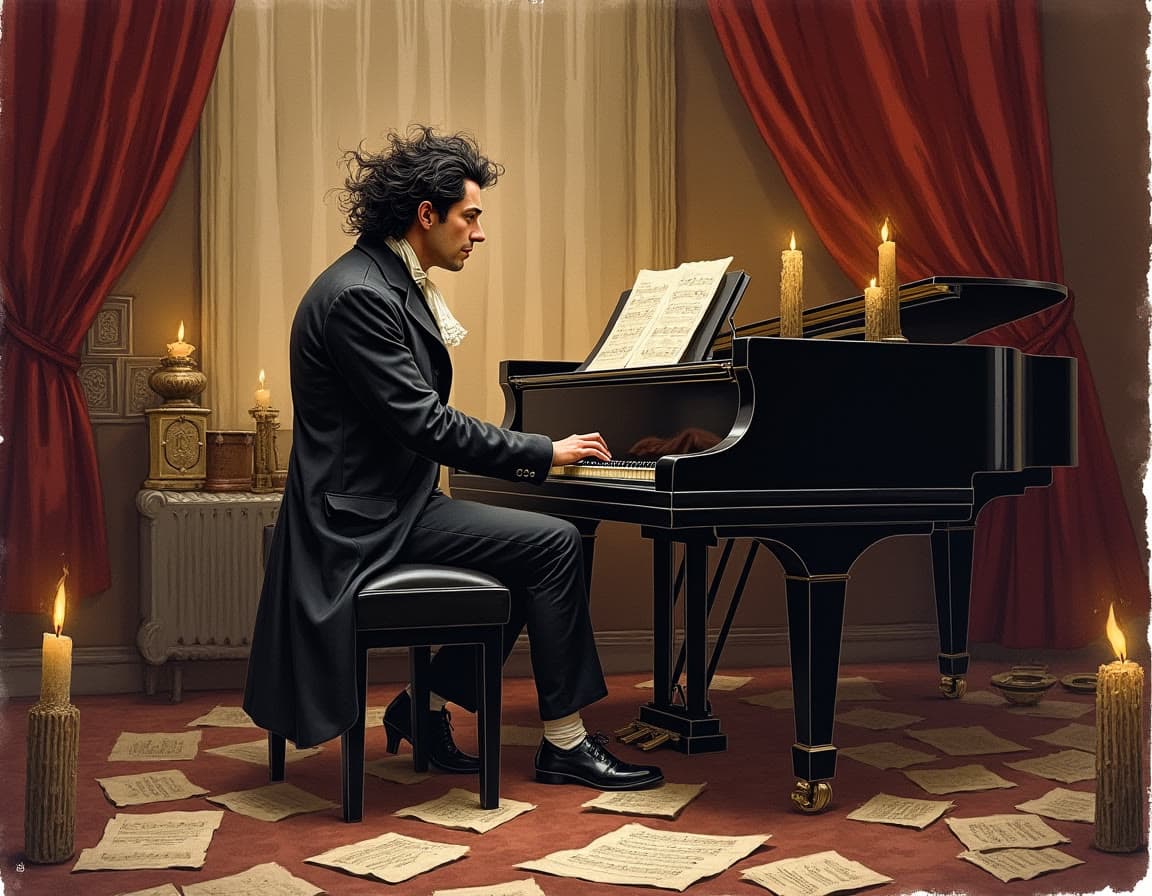
Beethoven's notoriously messy living quarters became something of a local legend in Vienna, with visitors describing rooms cluttered with half-eaten meals, discarded manuscript pages, and an out-of-tune piano, all while dozens of unopened letters from admirers and publishers piled up around him, evidence of a mind so thoroughly absorbed in musical composition that mundane domestic order simply ceased to matter.
贝多芬:听不见的乐圣
Ludwig van Beethoven was born in 1770 in the German city of Bonn, into a household dominated by his father, an ambitious and often abusive court musician who recognized his young son's prodigious musical talent early and resolved, with considerable harshness, to mold him into a celebrated child prodigy comparable to Mozart.
本次阅读生字复习
你还没有收藏这本书的生字
点击内文中任何一个单字,按下「⭐️ 加入我的生字本」,读完后就会在这里出现复习卡片。