 第 2 册🔥 CEFR B1・中级
《爱因斯坦:时空的奥秘》分级有声读物全系列共 2 册
爱因斯坦:弯曲的时空
Albert Einstein: The Curving of Spacetime
在狭义相对论震惊学界后,爱因斯坦展开长达十年的艰苦思考。他提出惊人的广义相对论:大质量天体会使时空本身弯曲,并在 1919 年日食观测中获得证实,一跃成为全球科学巨擘。
CEFR B1・中级⏱️ 约 4 分钟📝 513 字
系列集数(第 2 / 2 册)
《爱因斯坦:时空的奥秘》分级有声读物・第 2 册第 1 / 26 句
爱因斯坦:弯曲的时空
Albert Einstein: The Curving of Spacetime
0:00
故事全文(1/26)
字级
第 1 段
Following the astonishing triumph of his 1905 Miracle Year, Albert Einstein had become a respected figure in European science. His Special Theory of Relativity had proven that time and space are flexible, and that energy and mass are deeply connected. Yet in the quiet moments of his private contemplation, Albert knew that his work was incomplete.
第 2 段
The special theory had one glaring limitation: it only applied to objects moving at constant, unvarying speeds in straight lines. It could not account for acceleration, nor could it explain the mysterious pull of gravity that holds planets in their orbits around the sun. For centuries, Sir Isaac Newton's law of universal gravitation had stood unchallenged as the ultimate truth of physics. But Newton could never explain how gravity actually worked across empty space.
第 3 段
In 1907, while sitting at his desk in Bern, what Einstein later called 'the happiest thought of my life' suddenly flashed into his mind. He realized that if a person falls freely from the roof of a house, they will not feel their own weight! Acceleration and gravity produce the exact same physical effects. This profound realization, known as the Equivalence Principle, became the golden key that would unlock a brand new vision of the cosmos.
第 4 段
For eight grueling years, through political turmoil and the outbreak of World War I in Europe, Einstein wrestled with the complex mathematical equations needed to describe this new reality. He worked in deep solitude in Berlin, filling hundreds of scrap pages with tensor calculus, often suffering from severe exhaustion. Yet his belief in the mathematical harmony of nature never wavered.
第 5 段
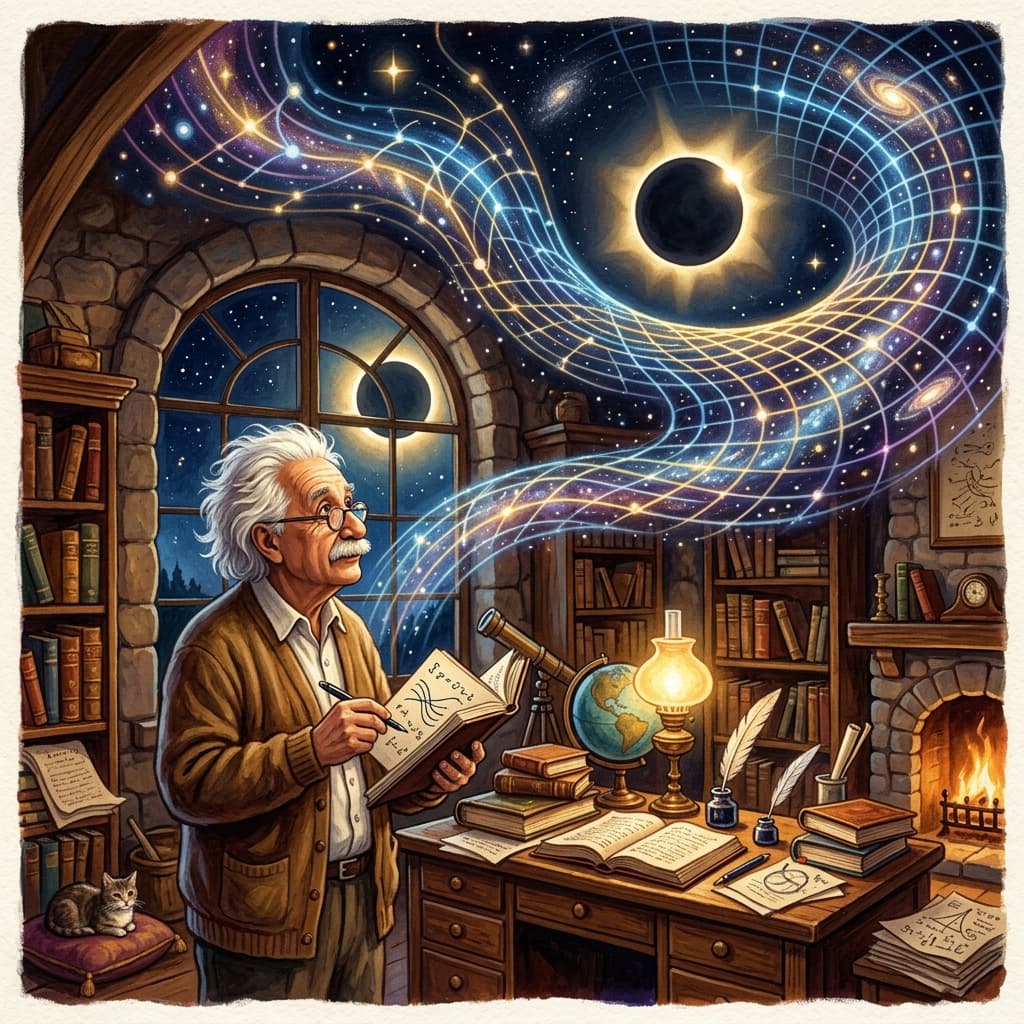
Finally, in November 1915, Einstein presented his completed General Theory of Relativity to the Prussian Academy of Sciences. His revolutionary proposal was breathtaking: space and time are not an empty, rigid stage upon which events happen. Instead, spacetime is a flexible, dynamic fabric! Heavy cosmic objects—like the sun and massive stars—warp and curve the fabric of spacetime around them, just as a heavy bowling ball creates a deep bowl when placed upon a soft mattress.
第 6 段
According to Einstein, planets do not orbit the sun because of an invisible pulling force; they simply follow the natural curved contours of spacetime created by the sun's enormous mass! Even beams of light, traveling through the curved space near a star, must bend along that curvature.
第 7 段
In May 1919, a British scientific expedition led by astronomer Arthur Eddington traveled to the tropical island of Principe to test Einstein's bold prediction during a total solar eclipse. When the moon blocked the sun's blinding glare, astronomers photographed the stars positioned just behind the darkened edge. When the plates were developed, the starlight had bent by the exact mathematical angle predicted by Einstein's equations!
第 8 段
Headlines across the globe announced a scientific revolution: 'Lights All Askew in the Heavens—Men of Science More or Less Agog!' Albert Einstein became an international icon of human intellect and peaceful cooperation. His general relativity revealed a universe that was grander, stranger, and more harmonious than humanity had ever dared to imagine.
爱因斯坦:弯曲的时空
Following the astonishing triumph of his 1905 Miracle Year, Albert Einstein had become a respected figure in European science.
《爱因斯坦:时空的奥秘》分级有声读物 系列章节目录

本次阅读生字复习
你还没有收藏这本书的生字
点击内文中任何一个单字,按下「⭐️ 加入我的生字本」,读完后就会在这里出现复习卡片。