 第 1 册🔥 CEFR B1・中级
《李奥纳多·达文西》传记有声书全系列共 1 册
达文西:好奇心与天才笔记
Leonardo da Vinci: The Notebook of Wonders
从托斯卡尼小镇的自然观察者,到佛罗伦斯画坊的天才学徒,达文西用永无止境的好奇心解构鸟类飞行、水流涡旋与人体奥秘,在笔记本中绘制出超越时代数百年的发明蓝图。
CEFR B1・中级⏱️ 约 3 分钟📝 459 字
《李奥纳多·达文西》传记有声书・第 1 册第 1 / 21 句
达文西:好奇心与天才笔记
Leonardo da Vinci: The Notebook of Wonders
0:00
故事全文(1/21)
字级
第 1 段
In the small hillside village of Vinci, overlooking the sun-drenched vineyards of Tuscany, a boy named Leonardo was born in 1452. From his earliest childhood, Leonardo was captivated by the endless beauty of the natural world. While other children learned Latin grammar from dry textbooks, Leonardo wandered through the hills, watching how water formed swirling whirlpools in mountain streams and sketching the graceful flight of swallows across the open sky.
第 2 段
Leonardo had an insatiable appetite for wonder. He wrote his thoughts in private notebooks using a peculiar mirror script—writing backwards from right to left so that his words could only be read when held up to a mirror! On every page, brilliant sketches of flowers, horses, mechanical gears, and human muscles mingled together, demonstrating that art and science are twin branches of the same great tree.
第 3 段
Recognizing his son's extraordinary artistic gift, his father took young Leonardo to the vibrant city of Florence. There, he entered the bustling workshop of master Andrea del Verrocchio. Verrocchio's studio was not merely an art school; it was an experimental laboratory of sculpture, metallurgy, geometry, and painting. Leonardo learned to mix vibrant pigments, cast heavy bronze, and observe how light and shadow fall across curved surfaces with absolute accuracy.
第 4 段
One day, Verrocchio asked his young apprentice to paint an angel in the corner of a large canvas depicting the baptism of Christ. When the master saw the finished figure—painted with such delicate grace, luminous skin, and lifelike breath—Verrocchio was moved to tears. Legend says that the master set down his brush and vowed never to touch paints again, recognizing that his pupil had far surpassed him.
第 5 段
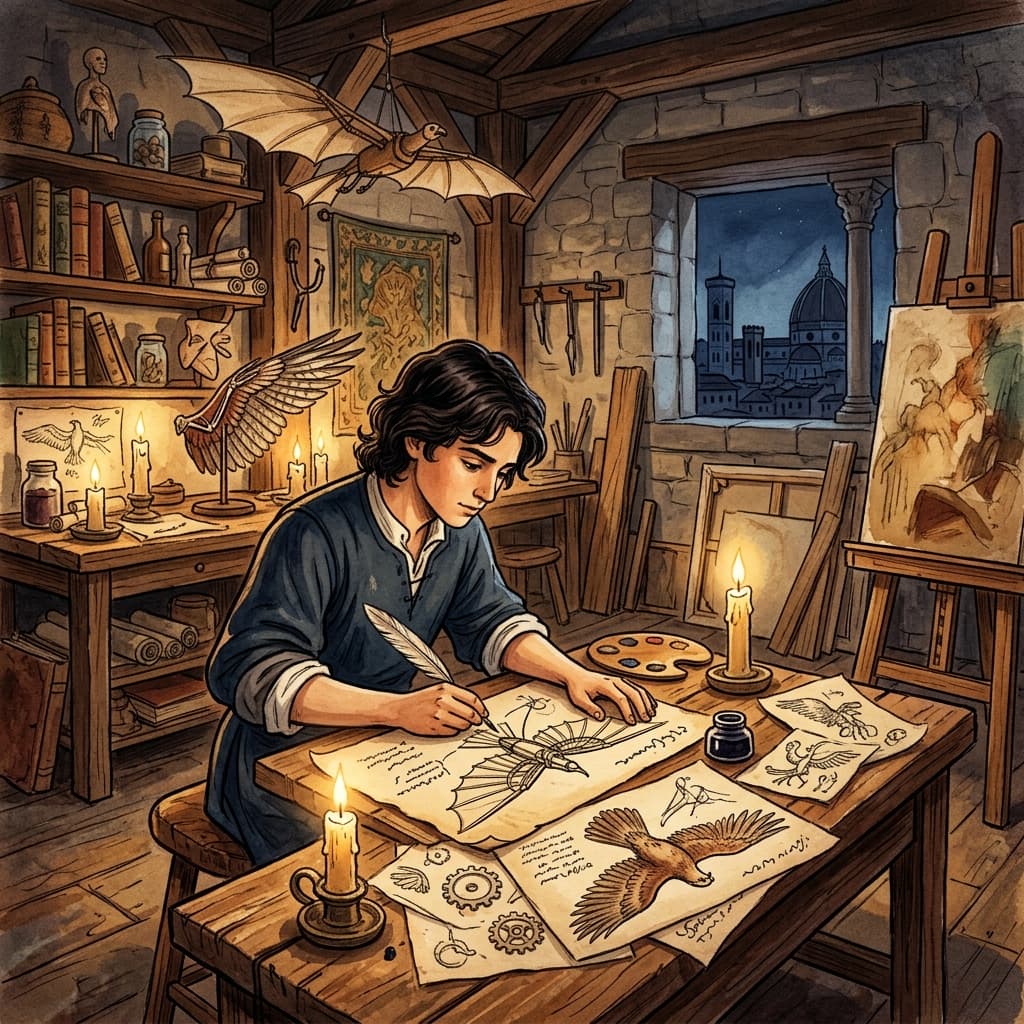
Yet Leonardo was never satisfied with mere surface beauty; he needed to understand the hidden mechanisms beneath everything he observed. To paint human figures accurately, he spent nights in candlelit hospitals studying human anatomy, discovering how muscles flex and tendons pull. To design faster ships, he studied the fluid dynamics of water currents. To dream of human flight, he dissected the wings of birds and bats, designing mechanical flying machines and parachutes centuries before the invention of the airplane.
第 6 段
Later in Milan, working for the Duke Ludovico Sforza, Leonardo created some of the most celebrated masterpieces in human history, including the magnificent fresco of 'The Last Supper' and the enigmatic portrait of the 'Mona Lisa.' His paintings breathed with subtle life because every brushstroke was informed by decades of deep scientific observation.
第 7 段
The journey of Leonardo da Vinci reminds us that true genius is not a magical gift, but an unyielding commitment to curiosity. With an observant eye, a restless notebook, and a boundless imagination, the master of Florence proved that to truly see the world is to transform it forever.
达文西:好奇心与天才笔记
In the small hillside village of Vinci, overlooking the sun-drenched vineyards of Tuscany, a boy named Leonardo was born in 1452.
本次阅读生字复习
你还没有收藏这本书的生字
点击内文中任何一个单字,按下「⭐️ 加入我的生字本」,读完后就会在这里出现复习卡片。