 Book 1📘 CEFR A2・Elementary
Orpheus and Eurydice — Classic Greek Myth Series1 books in this series
Orpheus and Eurydice: The Song in the Shadow
The master musician Orpheus descends into the Underworld with his golden lyre to reclaim his beloved Eurydice. His sublime melodies soften the hearts of Charon, Cerberus, and Hades himself, winning her release — under one tragic, unforgettable condition.
CEFR A2・Elementary⏱️ ~9 min📝 1260 words
Orpheus and Eurydice — Classic Greek Myth Series・Book 1Sentence 1 / 68
Orpheus and Eurydice: The Song in the Shadow
0:00
Full story(1/68)
Text size
Paragraph 1
In the lush green valleys of ancient Thrace, there lived a poet and musician named Orpheus. His father was Apollo, the god of music and light, and his mother was Calliope, the chief of all the inspirational Muses. From his birth, Orpheus was blessed with the most magnificent golden voice and the most sublime skill upon the lyre that the world has ever known.
Paragraph 2
When Orpheus touched the strings of his seven-stringed lyre and began to sing, magic swept over the mortal world. Savage lions and fierce wolves lay down peacefully like gentle lambs; swift mountain rivers ceased their rushing to listen to his melodies; and ancient oak trees uprooted themselves from rocky hillsides to lean closer to his music. Even the cold grey stones seemed to soften beneath his song.
Paragraph 3
Despite all his fame and divine gifts, Orpheus's heart remained humble until the day he laid eyes upon Eurydice, a graceful wood nymph whose beauty was as pure and radiant as a morning blossom. When their eyes met, they fell deeply and completely in love. Their joyful wedding was celebrated with music and dancing across the sunlit meadows of Greece.
Paragraph 4
Yet fate is often cruel, even to the most beloved of mortals. Shortly after their wedding day, Eurydice was strolling through a meadow of tall grass with her companion nymphs. A venomous viper, hidden beneath the thick green weeds, struck her ankle with lightning speed. The deadly poison coursed through her veins, and before help could arrive, gentle Eurydice closed her eyes and her spirit departed for the dark realm of the Underworld.
Paragraph 5
When Orpheus discovered his beloved's lifeless body, his heart was shattered into a thousand pieces. He picked up his golden lyre and began to sing a song of such raw, overwhelming sorrow that the birds stopped singing in the branches, the leaves fell from the trees in mourning, and even the immortal gods on Mount Olympus wept tears of pity.
Paragraph 6
For days and nights, Orpheus wandered alone, unable to eat, sleep, or find comfort. He realized that life without Eurydice was an unbearable wasteland. In his desperation, Orpheus resolved to attempt what no living mortal had ever dared: he would journey into the shadowy depths of the Underworld and plead with Hades, the Lord of the Dead, to return his beloved wife.
Paragraph 7
Guided only by his love and his golden lyre, Orpheus traveled to the dark southern cavern of Taenarum, where a yawning black fissure led down into the subterranean world. He stepped into the suffocating gloom and descended along steep, treacherous paths into the cold, silent depths beneath the earth.
Paragraph 8
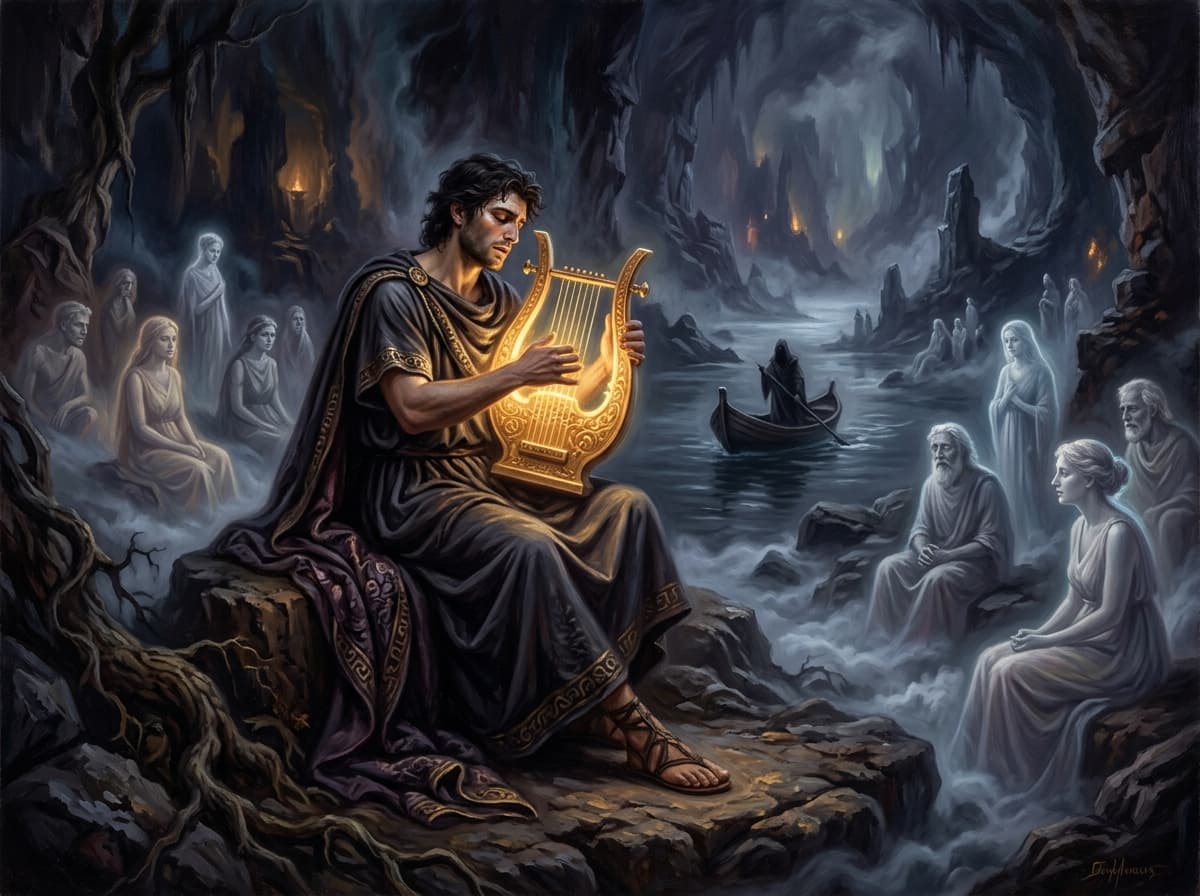
At last, Orpheus arrived at the misty banks of the River Styx, the dark boundary between the living and the dead. Countless pale spirits of the deceased stood along the shore, waiting for Charon, the grim and ancient ferryman, to row them across the black waters in his wooden boat. When Charon saw a living man approach, he raised his heavy oar in fury, refusing passage.
Paragraph 9
Instead of shouting or drawing a blade, Orpheus lifted his lyre and began to play. The sweet, haunting melody resonated across the silent river. The ancient ferryman listened, his cold eyes filling with tears for the first time in millennia. Without a word, Charon lowered his oar, gestured for Orpheus to step into the boat, and gently rowed him across the river of sorrow.
Paragraph 10
On the far bank stood Cerberus, the colossal three-headed hound of the Underworld, whose jagged fangs dripped poison and whose mane bristled with hissing serpents. The monstrous beast growled with a sound like grinding mountains and prepared to leap upon the intruder.
Paragraph 11
Orpheus did not flee. He strummed a soft, soothing lullaby upon his lyre. The sweet music wrapped around the ferocious beast like a warm blanket. Cerberus's fierce eyes drooped, his three massive heads sank to the stone floor, and the terrifying guardian fell into a deep and peaceful slumber.
Paragraph 12
Orpheus walked past the sleeping beast and entered the gloomy, vaulted palace of the Underworld. High upon a throne of dark obsidian sat Hades, the grim and unyielding King of the Dead, beside his beautiful queen, Persephone. The royal court was cold, silent, and filled with the shadowy shades of the departed.
Paragraph 13
Standing before the terrifying throne, Orpheus fell to one knee, touched the strings of his lyre, and poured his whole soul into song. He sang of the brief beauty of mortal love, of the agony of young hearts torn apart before their time, and of the inescapable truth that all mortals must one day arrive in Hades' realm.
Paragraph 14
'I have not come to conquer your kingdom or steal your riches,' Orpheus sang through his tears. 'I ask only for a few short years with my bride upon the sunlit earth. When our hair turns white, we will both return willingly to your peaceful kingdom forever.'
Paragraph 15
As the magnificent song echoed through the obsidian hall, all the torments of the Underworld ceased. Tantalus forgot his burning thirst; Sisyphus sat down upon his heavy boulder to listen; and the pale ghosts wept silent tears of remembrance. Queen Persephone openly wept into her mantle, and even the stern, iron heart of Hades was softened by the transcendent beauty of the music.
Paragraph 16
Hades raised his dark scepter and summoned the gentle shade of Eurydice from among the new arrivals. She stepped forward, still limping slightly from the serpent's bite, her eyes filled with wonder and love at the sight of her husband.
Paragraph 17
'Take her, Orpheus,' Hades commanded with solemn authority. 'Your music has won what no sword could ever conquer. But hear my strict condition: as you lead her back to the upper world, Eurydice will follow behind you. You must not turn around to look at her until both of you have stepped completely into the bright light of the sun. If you look back even once while in the shadows, she will be drawn back into the Underworld forever!'
Paragraph 18
Orpheus bowed in profound gratitude and began the long, arduous ascent. The path was steep, dark, and silent. He walked ahead, his heart pounding in his chest. In the oppressive gloom, he could not hear Eurydice's footsteps, for the dead move as quietly as falling mist. Doubts and terrible fears began to torment his mind: Was she truly following him? Had Hades deceived him?
Paragraph 19
Upward and upward he climbed, resisting the overwhelming urge to glance behind him. Finally, after hours of agonizing climbing, Orpheus saw the pale light of day shining through the cavern entrance ahead. With a joyful cry, Orpheus stepped out onto the sunlit grass of the upper earth!
Paragraph 20
Overcome with relief, love, and impatience, Orpheus turned around instantly to embrace his beloved. But in his haste, he forgot the god's exact words: Eurydice was still one step behind him, her feet still inside the shadow of the cavern! Orpheus reached out with trembling arms, but Eurydice's form began to dissolve into pale mist. 'Farewell, my love...' she whispered softly, her gentle voice fading away as she was pulled inexorably backward into the eternal darkness.
Paragraph 21
Orpheus tried desperately to rush back down into the cave, but the heavy gates were sealed shut against him, and Charon refused to row him across a second time. Orpheus returned to the Thracian hills, spending the rest of his days singing sorrowful songs that enchanted the forest creatures and rivers. His tragic story remains the world's most enduring reminder of the boundless power of love, the sublime beauty of art, and the painful fragility of human patience.
Orpheus and Eurydice: The Song in the Shadow
In the lush green valleys of ancient Thrace, there lived a poet and musician named Orpheus.
Auto-playing next book(5s)
Thor and the Stolen Hammer — Norse Myth Series · Book 1: Thor and the Stolen Hammer: The Giant's Feast
Vocabulary from this book
You haven't saved any words from this book yet
Tap any word in the story and hit "⭐️ Save to my vocabulary" — review cards will show up here once you finish.