 Book 1📘 CEFR A2・Elementary
Icarus — Classic Greek Myth Series1 books in this series
The Wings of Icarus
The master craftsman Daedalus builds wings of feathers and wax for his son Icarus to escape prison, warning him not to fly too close to the sun. The exhilarated youth ignores the advice, creating an enduring myth about human ambition and caution.
CEFR A2・Elementary⏱️ ~4 min📝 598 words
Icarus — Classic Greek Myth Series・Book 1Sentence 1 / 39
The Wings of Icarus
0:00
Full story(1/39)
Text size
Paragraph 1
Long ago, on the rocky island of Crete, there lived a legendary craftsman and inventor named Daedalus. Daedalus was famous throughout the ancient world for his brilliant mind. He had built the great Labyrinth—a twisting maze of endless corridors so confusing that no man who entered could ever find the way out.
Paragraph 2
The cruel king of Crete, Minos, wanted to keep all of Daedalus's inventions for himself. To prevent the master builder from ever leaving the island, King Minos locked Daedalus and his young son, Icarus, inside a high stone tower overlooking the Aegean Sea. Guards watched the palace gates, and swift warships patrolled the waters. There was no way to escape by land or by sea.
Paragraph 3
Day after day, Daedalus stood at the narrow stone window, watching white seagulls glide effortlessly across the blue sky. 'King Minos rules the land and the ocean,' Daedalus said thoughtfully to his son, 'but he does not rule the open air. That is the path we shall take to freedom!'
Paragraph 4
Daedalus began to collect thousands of fallen bird feathers from the tower roof. Patiently, he arranged the feathers in rows, from shortest to longest, stitching them together with strong linen thread. Then, he melted fragrant beeswax over a small flame to secure the feathers into curved wooden frames. Soon, two magnificent pairs of large wings lay on the stone floor.
Paragraph 5
Before strapping the wings onto his son's shoulders, Daedalus took Icarus by the hands and looked deeply into his eyes with great seriousness. 'Listen carefully to my warning, Icarus,' the father cautioned. 'You must fly a middle course. Do not fly too low, or the heavy sea spray will soak your feathers and drag you down into the waves. And never fly too high, or the blazing heat of the sun will melt the wax and destroy your wings. Keep close to me, and we shall reach safety.'
Paragraph 6
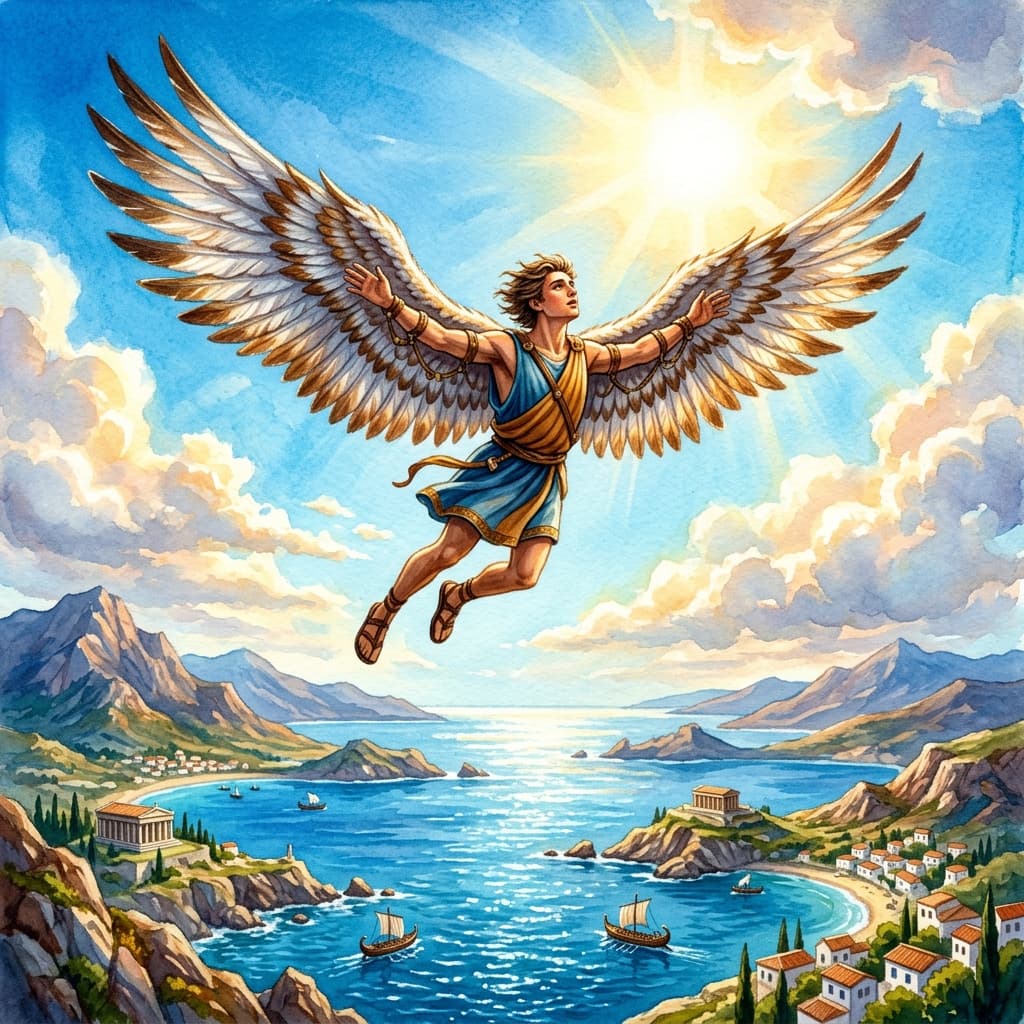
Young Icarus nodded eagerly, his heart pounding with excitement. They stepped onto the edge of the high stone window, spread their great wings, and leaped into the open air! To his astonishment, Icarus felt the cool wind catch beneath his arms. With a few powerful sweeps, he was flying—soaring like an eagle above the crashing waves below.
Paragraph 7
The joy of flight was unlike anything Icarus had ever dreamed. As they flew over distant green islands, fishermen looked up in wonder, believing they were seeing gods in the sky. But as the hours passed, the young boy became overly confident. He felt powerful, weightless, and invincible.
Paragraph 8
Forgetting his father's solemn warning, Icarus began to climb higher and higher into the bright blue heavens. He wanted to touch the golden light of the sun! Daedalus called out in terror from below, but his voice was swallowed by the roaring wind. As Icarus drew closer to the blazing sun, the fierce heat began to soften the beeswax.
Paragraph 9
Suddenly, warm wax dripped down his arms. Feathers began to loosen and flutter away into the wind like dry autumn leaves. In sheer panic, Icarus flapped his bare arms, but there were no feathers left to catch the air. Down, down he plunged into the deep blue ocean below.
Paragraph 10
With a breaking heart, Daedalus searched the waters, finding only scattered white feathers floating on the gentle waves. He landed on a nearby shore, weeping for his lost son, and named the surrounding sea the Icarian Sea in his memory. The story of young Icarus reminds us that while the human spirit longs to reach the stars, wisdom and humility must always guide our flight.
The Wings of Icarus
Long ago, on the rocky island of Crete, there lived a legendary craftsman and inventor named Daedalus.
Vocabulary from this book
You haven't saved any words from this book yet
Tap any word in the story and hit "⭐️ Save to my vocabulary" — review cards will show up here once you finish.