 Book 2📘 CEFR A2・Elementary
Robinson Crusoe — Graded Audiobook Series3 books in this series
Days on the Island
After the shipwreck, Robinson lives alone on a deserted island. He salvages tools and food from the wreck, builds a shelter, grows grain, tends goats, and keeps a diary of his daily hopes and fears.
CEFR A2・Elementary⏱️ ~9 min📝 1024 words
Robinson Crusoe — Graded Audiobook Series・Book 2
Days on the Island
0:00
Full story
Text size
Paragraph 1
Robinson woke on the beach after the shipwreck. He was tired, hungry, and wet. For a moment, he wanted to lie down and wait for death. Then he saw the broken ship in the water. It was not far from the shore. He understood that food, tools, and clothes might still be inside.
Paragraph 2
Robinson made a raft from wood. He tied the pieces together with rope from the ship. The sea was calm, so he pushed the raft toward the wreck. Inside the ship, he found bread, rice, water, clothes, knives, and a gun. He also found nails, a hammer, and a small box of tools.
Paragraph 3
He used a piece of cloth as a bag and filled it with small tools. He tied the bag to his back before he crossed the water. The raft moved slowly, but it stayed above the waves. Robinson looked at the wide sea and hoped that the old ship would give him enough help to begin again.
Paragraph 4
He made many trips from the ship to the island. Each trip was dangerous because the sea could change quickly. On the last trip, a strong wave moved the ship away. Robinson lost the ship, but he had already carried many useful things to the shore. He thanked God for the help.
Paragraph 5
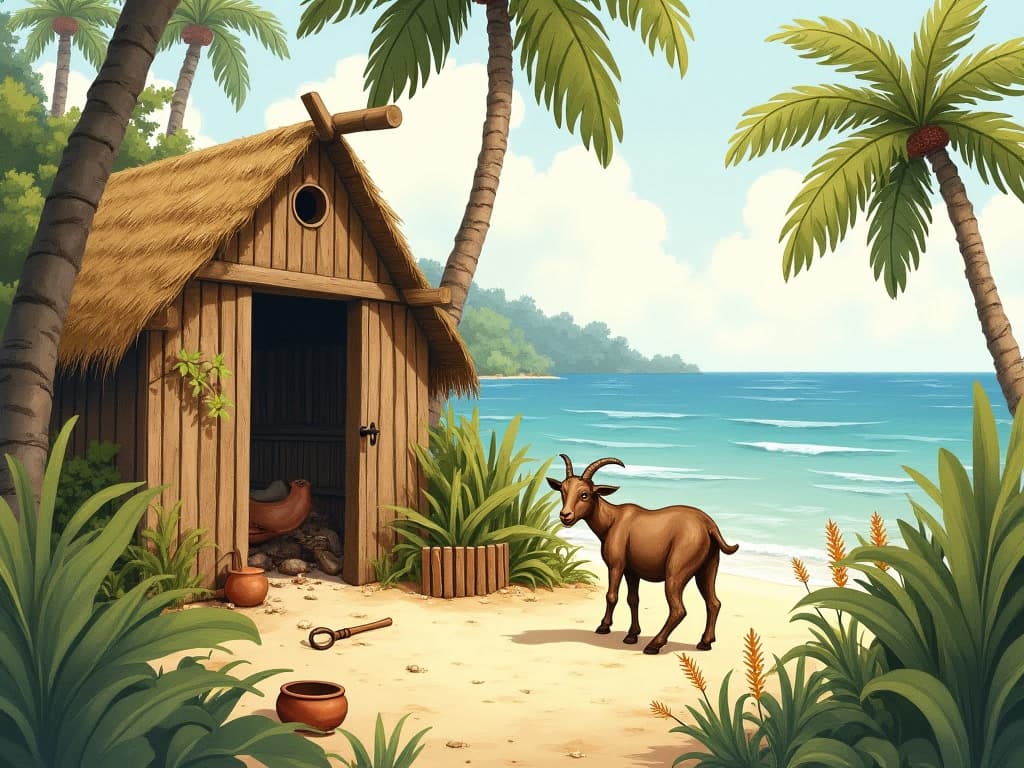
Robinson needed a home. He found a flat place near a hill and close to fresh water. He put strong sticks into the ground and made a high fence around the space. He used a ladder to climb over it. Inside the fence, he built a tent and covered it with cloth from the ship.
Paragraph 6
The place was small, but it was safe. Robinson kept his gun, food, and tools inside. He made a bed from leaves and wood. He placed a table near the wall and began to make a chair. His first chair fell apart, but he built another one. Every mistake taught him how to work better.
Paragraph 7
He explored the island carefully. There were green trees, high rocks, birds, and many kinds of fruit. He saw no houses and heard no human voice. He found wild goats on a hill. They ran away when he came near, so he made a plan to catch them without using all his bullets.
Paragraph 8
Robinson dug a deep hole near a path where the goats walked. He covered it with branches and leaves. The next morning, a young goat had fallen inside. Robinson pulled it out and took it to his home. Later, he caught another goat. Soon he had the beginning of a small group.
Paragraph 9
Robinson learned to grow food. He had found some rice and wheat in a bag from the ship. Some grains fell on the ground near his home. After the rain, small green plants appeared. Robinson was surprised. He built a fence around them and watched them grow. Later, he saved the seeds for another season.
Paragraph 10
He also learned to make bread. He had no oven and no mill, so the work took a long time. He used two stones to break the grain. He mixed the grain with water and made a small fire. The first bread was hard, but it was food. Robinson felt proud when he ate it.
Paragraph 11
The island had rainy and dry seasons. During the rain, the ground became soft and the river grew wide. During the dry season, the air became hot and the plants needed water. Robinson wrote down the weather in a notebook. He learned when to plant, when to hunt, and when to stay at home.
Paragraph 12
Robinson was lonely. He talked to his dog, his cat, and the birds near the fence. He read the few books he had saved from the ship. He wrote a diary and made two lists. One list said what was bad about his life. The other list said what was good. The second list slowly became longer.
Paragraph 13
One day, Robinson found a large footprint in the sand. It was not his footprint. He stood still and looked at it. His heart beat fast. People had come to the island, but he did not know who they were. He returned to his home and made the fence stronger.
Paragraph 14
For many days, Robinson watched the beach from far away. He found ashes and broken bones near the water. He believed that a group of people sometimes came to the island. They might be dangerous. Robinson stopped making fires in the open and kept his boat hidden among the trees.
Paragraph 15
Robinson did not know how long he would need to hide. He moved slowly and left no clear path to his home. He carried only a little food when he explored. If he heard a bird fly suddenly or a branch break, he stopped and waited. The island was his home, but it could also become a dangerous place.
Paragraph 16
Robinson became more careful, but he did not stop working. He made a second place in a cave near the hill. He stored food there in case he needed to leave his home. He kept a gun at each place. He also made a small cross and marked the years he had lived on the island.
Paragraph 17
He checked the path between the cave and the fence. A broken branch could show that someone had passed. A new mark in the sand could mean danger. Robinson made these checks every morning. The work was tiring, but it helped him feel ready. He had learned that a safe home needed care every day.
Paragraph 18
More than twenty years passed. Robinson's hair grew white, but his hands became strong from work. He could make clothes from animal skin, baskets from plants, and new tools from old metal. He did not have everything he wanted, but he could live with what the island gave him.
Paragraph 19
Then, one morning, he saw smoke on the far side of the island. Robinson felt the old fear return. He took his gun and walked quietly through the trees. Near the beach, he found signs of a fire and many footprints. He did not know that this day would change his lonely life forever.
Days on the Island
Tap to play the audiobook
Auto-playing next book(5s)
Robinson Crusoe — Graded Audiobook Series · Book 3: Friday and Home
Robinson Crusoe — Graded Audiobook Series — all books
Vocabulary from this book
You haven't saved any words from this book yet
Tap any word in the story and hit "⭐️ Save to my vocabulary" — review cards will show up here once you finish.