 第 2 册🔥 CEFR B1・中级
《海克力士十二试炼》希腊英雄有声书全系列共 2 册
海克力士:世界尽头的金苹果与地狱犬
Defying the Gods: The Golden Apples and Cerberus
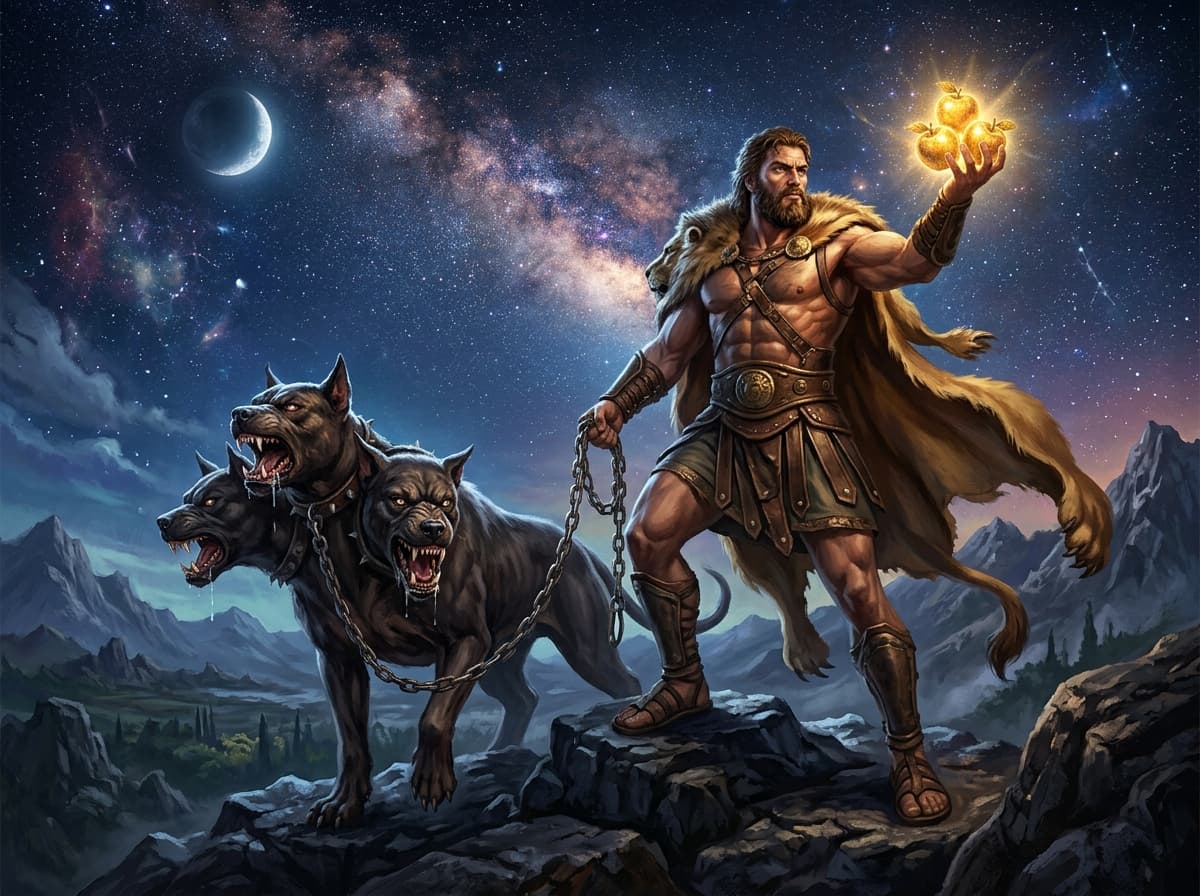
海克力士挑战最后的终极试炼:远征世界尽头,替泰坦巨人阿特拉斯短暂扛起整个苍穹天际,智取赫斯珀里得斯的金苹果;更深入阴森冥界,赤手空拳制伏三头地狱恶犬塞伯鲁斯。十二试炼功德圆满,海克力士终获永生,晋升为奥林帕斯不朽英雄。
CEFR B1・中级⏱️ 约 9 分钟📝 1200 字
《海克力士十二试炼》希腊英雄有声书・第 2 册第 1 / 60 句
海克力士:世界尽头的金苹果与地狱犬
Defying the Gods: The Golden Apples and Cerberus
0:00
故事全文(1/60)
字级
第 1 段
Having conquered the wildest beasts and monstrous terrors of the mortal world, Hercules stood undaunted. Yet King Eurystheus, consumed by spite and jealousy, knew that only six labors remained. Determined to find tasks that would break the hero's spirit or trap him beyond the edges of the mortal realm, the cowardly king devised trials that challenged the authority of the gods themselves.
第 2 段
For his Seventh Labor, Hercules sailed to the island of Crete to capture the Cretan Bull, a magnificent white beast that breathed scorching fire and ravaged the coastal farmlands. Hercules tackled the raging bull barehanded, wrestled its horns until it submitted, and carried it across the sea on his shoulders.
第 3 段
For his Eighth Labor, Hercules traveled to the cold northern kingdom of Thrace to capture the Man-Eating Mares of King Diomedes. Hercules tamed the savage horses and drove them safely south to Mycenae.
第 4 段
For his Ninth Labor, Eurystheus demanded the golden War Belt of Hippolyta, queen of the fierce Amazon warrior women. Hippolyta was so impressed by Hercules' honesty and noble reputation that she gladly offered the belt as a gift, though Hera provoked a battle in which Hercules proved his valor once more.
第 5 段
For his Tenth Labor, Hercules traveled to the far western island of Erytheia to capture the magnificent red cattle of the three-bodied giant Geryon. Along his journey, Hercules split the mountain ridge at the edge of the Mediterranean Sea with his bare hands, creating the famous Straits of Gibraltar—known throughout antiquity as the Pillars of Hercules.
第 6 段
Now only two labors remained, and Eurystheus saved the most impossible for last. For the Eleventh Labor, the king commanded: 'Bring me the Golden Apples of the Hesperides!' These miraculous golden fruits, a wedding gift from Gaia to Hera, grew in an enchanted orchard at the western edge of the world. The garden was guarded by the singing nymphs of the evening, and by Ladon, a colossal dragon with one hundred heads that never slept.
第 7 段
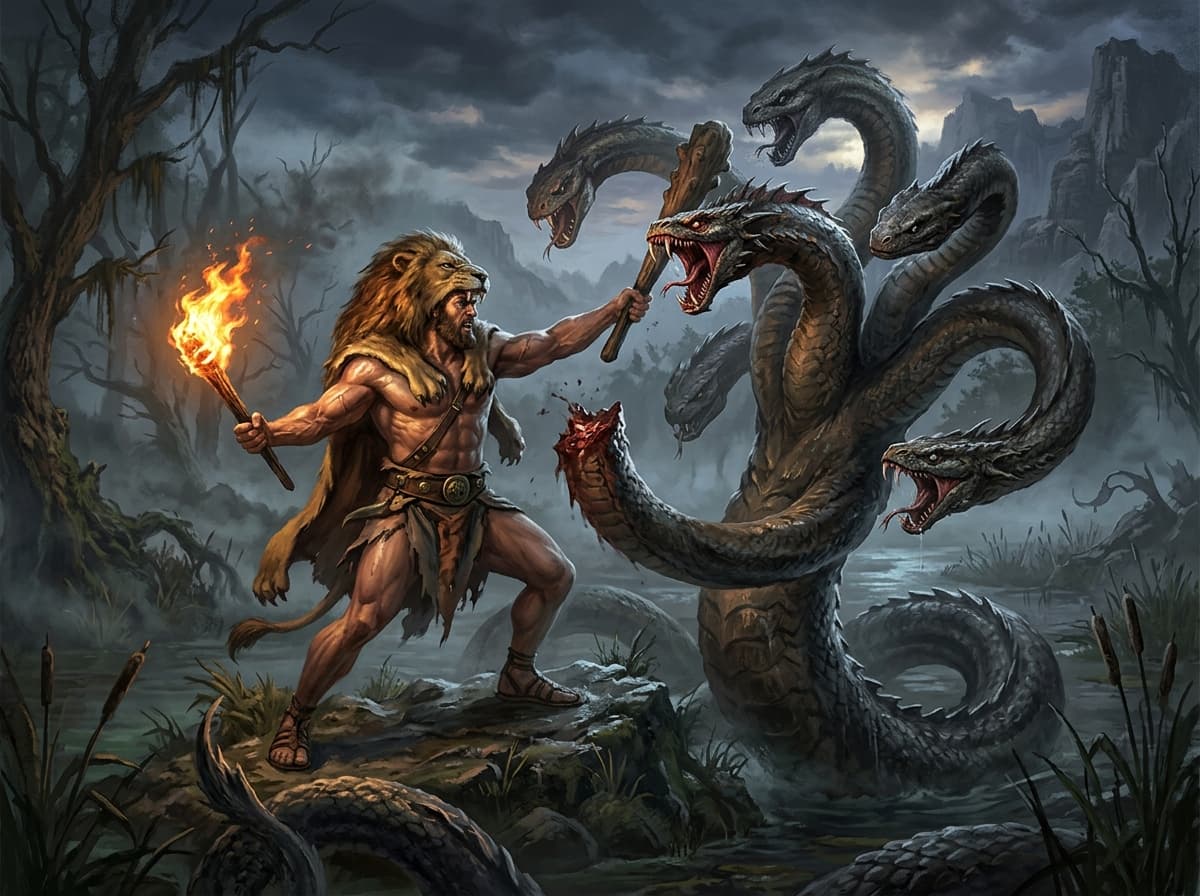
No mortal knew the secret location of the garden. Hercules wandered across continents, seeking guidance from river gods and wise spirits. In the frozen heights of the Caucasus Mountains, Hercules discovered the Titan Prometheus, who had hung chained to the cliff for centuries. Moved by compassion, Hercules shot the tormenting eagle with a poisoned arrow and shattered the adamantine chains with his colossal strength, freeing the Titan.
第 8 段
In deep gratitude, Prometheus shared a vital secret: 'Do not enter the garden of the Hesperides yourself, Hercules. Instead, find the Titan Atlas, who holds the celestial heavens upon his shoulders. Atlas is the father of the Hesperides; he alone can walk into the garden and pick the golden apples without angering the gods.'
第 9 段
Hercules journeyed to the westernmost edge of the world, where the ocean meets the sky. There he found Atlas, a colossal Titan groaning under the crushing weight of the entire celestial vault of the universe. The stars, planets, and blue sky rested heavily upon the giant's broad shoulders.
第 10 段
Hercules approached the giant and offered a daring bargain: 'Atlas, if you will walk into your daughters' garden and fetch me three golden apples, I will take the weight of the heavens upon my own back while you are gone.'
第 11 段
Atlas eagerly agreed. Hercules knelt, positioned his muscular shoulders beneath the celestial vault, and took the weight of the sky. The crushing pressure was unlike anything the hero had ever experienced: every muscle strained like iron cables, his bones groaned under the weight of the stars, and his feet sank into the solid earth. Yet his divine willpower held the universe aloft.
第 12 段
After what felt like an eternity, Atlas returned holding three radiant golden apples that shone like morning sunlight. But having tasted freedom for the first time in millennia, Atlas smiled deceitfully. 'I have carried the sky for ten thousand years,' Atlas announced. 'You hold it so well, Hercules! I shall take these golden apples to Eurystheus myself, and you may hold the heavens in my place!'
第 13 段
Hercules realized that force could not compel the giant, so he turned to cunning wit. 'Very well, Atlas,' Hercules said with a calm and respectful smile. 'I accept my fate. But the edge of the sky is sharp, and it chafes my shoulders painfully. Would you kindly take the heavens back for just one brief moment, so I may fold my lion skin into a soft pad for my neck?'
第 14 段
The simple-minded Titan, suspecting no trick, placed the golden apples on the green grass and took the celestial vault back onto his broad shoulders. The instant the weight transferred, Hercules picked up the three golden apples, gave a polite bow, and said: 'Farewell, Atlas! May the stars shine gently upon your shoulders!' He walked away with a broad smile, leaving the tricked Titan to carry the sky for eternity.
第 15 段
Eurystheus was speechless with terror when Hercules presented the golden apples. In absolute desperation, the king commanded the Twelfth and Final Labor—the most terrifying task ever conceived: 'Descend into the Underworld, into the very realm of the dead, and bring back Cerberus, the three-headed hound of Hades, alive and uninjured!'
第 16 段
To enter the Underworld while alive was considered impossible, but guided by Hermes and Athena, Hercules descended through a dark cavern at Cape Taenarum. He crossed the River Styx and marched into the obsidian palace of Hades, King of the Dead.
第 17 段
Standing before the dark throne, Hercules respectfully requested permission to take the guardian hound to the upper world. Hades looked upon the hero with grim curiosity and agreed on one strict condition: 'You may take Cerberus to King Eurystheus, provided you master him using only your bare hands and your lion skin—without drawing a sword, spear, or club!'
第 18 段
Hercules strode to the gates of the Underworld, where Cerberus stood growling with three colossal heads, razor-sharp fangs, and a tail tipped with a hissing dragon's head. The beast lunged with terrifying fury, but Hercules wrapped his massive arms around all three necks simultaneously in an unbreakable lock.
第 19 段
Cerberus thrashed, bit, and clawed against the hero's lion skin cloak, but the impenetrable pelt deflected the venomous claws. Hercules squeezed with relentless, steady power, cutting off the beast's breath until the three-headed hound weakened, ceased its struggle, and submitted completely to the hero's mastery.
第 20 段
Leading the subdued monster on a chain like a tame dog, Hercules ascended from the Underworld and brought Cerberus into the bright daylight of Mycenae. When King Eurystheus saw the three-headed hellhound growling outside his palace, he shrieked in absolute terror, dove into his bronze jar, and cowered in the dark, weeping and begging Hercules to return the beast to Hades immediately.
第 21 段
Hercules graciously returned Cerberus to the Underworld, his twelve impossible labors finally complete. His soul was cleansed of sorrow, his honor restored, and his fame immortalized across the ancient world.
第 22 段
When his mortal life eventually came to an end, Zeus reached down from the clouds and brought his heroic son up to Mount Olympus, granting him eternal life among the immortal gods. The Twelve Labors of Hercules remain the ultimate testament in human lore that courage, mental resolve, and perseverance can conquer the heaviest burdens and elevate the human spirit to the stars.
海克力士:世界尽头的金苹果与地狱犬
Having conquered the wildest beasts and monstrous terrors of the mortal world, Hercules stood undaunted.
自动播放下一集(5秒)
《爱丽丝梦游仙境》分级有声读物・第 1 册:掉进兔子洞
《海克力士十二试炼》希腊英雄有声书 系列章节目录
本次阅读生字复习
你还没有收藏这本书的生字
点击内文中任何一个单字,按下「⭐️ 加入我的生字本」,读完后就会在这里出现复习卡片。